

Introduction
Iran is a country with very high climatic diversity, from 95% humidity in the north to 72-degree temperatures in Khuzestan and acid rain in metropolises. These harsh conditions reduce the useful life of many imported seismic joint covers to less than 5 years.
In this comprehensive and highly technical article, we examine how each weather factor affects the mechanical performance, aesthetics, and durability of seismic joint covers, and which materials and Agor Ehtad models are the best choice in each region of Iran.
Climatic factors affecting seismic joint covers in Iran
1. Severe temperature changes (−25 to +72 °C)
Iran has one of the highest annual temperature ranges in the world. These changes cause severe expansion and contraction of profiles.
- Thermal expansion coefficient of ordinary aluminum 6063: 23.4 × 10⁻⁶ m/m.°C
- Polycarbonate: 65–70 × 10⁻⁶ m/m.°C
- Stainless steel 316L: 17.3 × 10⁻⁶ m/m.°C
Conclusion: If the expansion coefficient difference is not compensated, profiles will buckle in Khuzestan’s summer and separate from the frame in Ardabil’s winter.
2. High humidity and acid rain (north and south)
Relative humidity above 80% combined with acid rain (pH < 4.5 in Tehran and Tabriz) causes galvanic and pitting corrosion.
3. Intense UV radiation (all of Iran except the northern strip)
UV radiation in Iran is up to 40% higher than the European average. This radiation causes ordinary EPDM to become brittle and uncoated polycarbonate to yellow.
4. Dust and fine particulate matter (center, south, and east)
The entry of silica particles with hardness of 7 into the joint causes abrasion of sealing strips.
Impact of each factor on common seismic joint cover materials
| Weather factor | Raw aluminum | Anodized aluminum | Steel 316 | Ordinary EPDM | UV-resistant EPDM | Ordinary polycarbonate | Polycarbonate + co-extruded UV |
|---|---|---|---|---|---|---|---|
| Severe temperature changes | Buckling | Suitable | Excellent | Cracking | Suitable | Surface cracking | Excellent |
| Humidity + acid rain | Severe corrosion | Good | Excellent | Suitable | Suitable | No effect | No effect |
| UV radiation | No effect | No effect | No effect | Embrittlement | Excellent | Severe yellowing | No yellowing for 25 years |
| Dust and abrasion | Scratches | Low scratches | Excellent | Abrasion | Low abrasion | Severe scratches | Low scratches (Hard-Coat) |
If you want more details about material behavior, read the specialized article Comparison of metal and elastomeric seismic joint covers.

Introduction of Agor Ehtad specialized models for different weather conditions of Iran
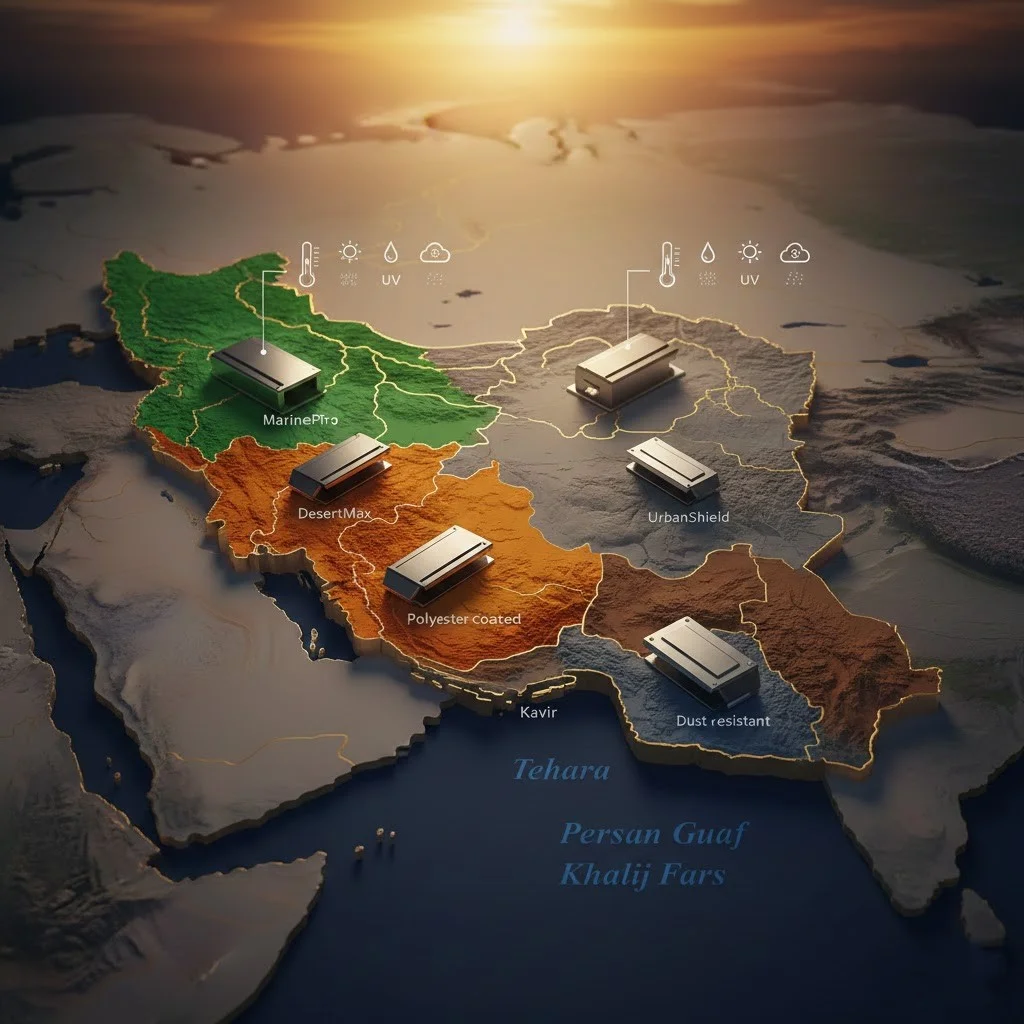
DesertMax series – For hot, dry, and dust-prone regions (Khuzestan, Kerman, Sistan)
- Aluminum profile 6063-T6 with 100-micron thick powder polyester coating (5000 hours Salt Spray resistance)
- VMQ silicone sealing strip resistant up to 250 degrees
- Automatic dust evacuation system (Dust-Free Channel)
- Implemented in Ahvaz Airport and Bandar Abbas Refinery
MarinePro series – For coastal and humid regions (Caspian Sea and Persian Gulf)
- Profile and screws entirely made of duplex 316L stainless steel
- Peroxide-cured EPDM sealing strip resistant to ozone and salt
- Epoxy + marine polyurethane coating
- Implemented in Toranj Kish Hotel and towers in District 22 of Tehran
UrbanShield series – For metropolises and acid rain
- Anodized aluminum 25 microns + nano-ceramic coating
- PTFE + hybrid silicone strips
- 10,000 hours QUV test resistance
You can see the latest innovations used in these three series in the article Innovations in UV and temperature-resistant seismic joint covers.
Guide for selecting seismic joint covers based on city or region
| City / Region | Temperature | Humidity | UV | Dust | Agor recommended model | Tehran, Isfahan, Shiraz | −10 to 45 | Medium | Very high | Medium | UrbanShield | Khuzestan, Bushehr | 0 to 70 | High | Very high | High | DesertMax + MarinePro | Mazandaran, Gilan | −5 to 38 | Very high | Medium | Low | MarinePro | Tabriz, Ardabil | −25 to 40 | Medium | High | Low | UrbanShield + thermal insulating washers | Kerman, Yazd | −15 to 55 | Low | Very high | Very high | DesertMax |
|---|
Implementation and maintenance tips in Iran’s harsh conditions
In hot and dry region projects (such as Khuzestan and Sistan), be sure to use 316 stainless steel screws with Teflon washers to prevent loosening due to thermal expansion. In northern and coastal regions, inspect the silicone sealing and EPDM strips at least every 6 months and replace them if necessary. In metropolises, annual washing with a water jet and nano-protective materials is recommended to neutralize the effects of acid rain and pollution.
Additionally, installing a rainwater drainage system (Drain Channel) is mandatory in all models to prevent water accumulation and freezing. Strict adherence to these implementation tips ensures that Agor Ehtad’s 10-year warranty remains fully valid even in the harshest weather conditions of Khuzestan, Kish, and Tehran.

Case study: 42-story tower in Ahvaz (Summer 2024-2025)
- Ambient temperature up to 68 degrees
- Relative humidity 85%
- Selected model: DesertMax with 120-micron polyester coating
- Result after 18 months: No corrosion, color change, or reduction in movement performance
Conclusion
Iran’s weather conditions are much more stringent than European standards. Wrong material selection can increase repair and replacement costs by up to 10 times. Using specialized models designed precisely for each region (such as Agor Ehtad’s DesertMax, MarinePro, and UrbanShield series) not only increases useful life to 25 years but also drastically reduces maintenance costs.
To receive free consultation and accurate model selection based on your city and project conditions, send your plan or location now. The Agor Ehtad technical team will send a complete technical proposal + 3D rendering + price within 48 hours.
For a complete view, visit Agor Ehtad specialized seismic joint cover products.
FAQ
1. How many years does an ordinary aluminum seismic joint cover last in Khuzestan?
Usually 3–4 years; then it undergoes severe corrosion.
2. What is the best material for northern and coastal regions?
Duplex 316L stainless steel + VMQ silicone (MarinePro series).
3. Does polycarbonate turn yellow in hot cities?
Only models without a co-extruded UV layer; Agor models have a 25-year non-yellowing warranty.
4. How much more do resistant models cost?
30–50% more expensive, but maintenance costs become zero over 10 years → 100% return on investment.