



In the world of modern construction, building seismic joint covers are considered one of the vital elements for ensuring the safety, durability, and beauty of structures. But when it comes to old buildings, those built before recent decades and without observing modern standards like Regulation 2800, the challenges double. These buildings, often scattered in populous cities like Tehran and Karaj, face problems such as uneven soil settlement, moisture penetration, dust ingress, and even earthquake risks.
In this comprehensive article, we will deeply examine the challenges of seismic joint covers in old buildings. We will also introduce modern renovation solutions and share real experiences from projects executed with Agor Company products. Agor Company, as one of the pioneers in manufacturing seismic joint cover profiles, offers solutions that not only increase safety but also preserve facade aesthetics with modern designs. Next, we will first discuss the history of the seismic joint concept to provide a context for understanding the challenges.
History of seismic joints and their evolution in Iranian construction
The concept of seismic joints is rooted in the bitter experiences of historical earthquakes. Since ancient times, engineers realized that adjacent buildings might collide during ground shaking and cause irreparable damage. In Iran, this concept became prominent with devastating earthquakes such as the Bam earthquake in 2003 (1382 SH) or the Rudbar earthquake in 1990 (1369 SH). According to historical studies, in old Qajar and Pahlavi buildings, there was often no distance between structures, leading to chain collapse.
The evolution of seismic joint cover regulations in Iran began in the 1970s (1350s SH), when initial standards based on global experiences such as California earthquakes entered the national building regulations. In Section 3 of the National Building Regulations (Protection of Buildings Against Fire), emphasis was placed on creating empty spaces to prevent force transmission. But in old buildings, often built before these laws, seismic joint covers were made with traditional materials like brick or cement, which were not only inflexible but also increased the risk of stress transmission.
In recent decades, with the fourth edition of Regulation 2800 (2019-2020 SH / 1399), stricter requirements were established for building seismic joint covers. For example, the minimum joint width must be 1/100 of the building height, but in old structures, this value is often below standard. Agor Company has followed this evolution by producing PVC and aluminum profiles, offering products compatible with the history of safety. To better understand the differences, you can read the article 5 Differences Between Seismic and Expansion Joints: A Complete and Comprehensive Guide on the Agor website, which provides a technical comparison of these concepts.
This history shows that seismic joint covers are not only a technical necessity but also part of the evolution of urban safety. In the next section, we will discuss Iran’s national regulations to better understand the challenges.
Iran’s National Building Regulations regarding seismic joint covers
Iran’s National Building Regulations, especially Sections 3, 4, 6, and 19, play a key role in defining seismic joint covers. According to Section 4 (General Building Requirements), third edition (2017-2018 SH / 1396) and 2025-2026 updates, the seismic joint must be covered in a way that does not prevent the transmission of compressive forces during an earthquake. For old buildings, which often lack these joints, renovation is mandatory.
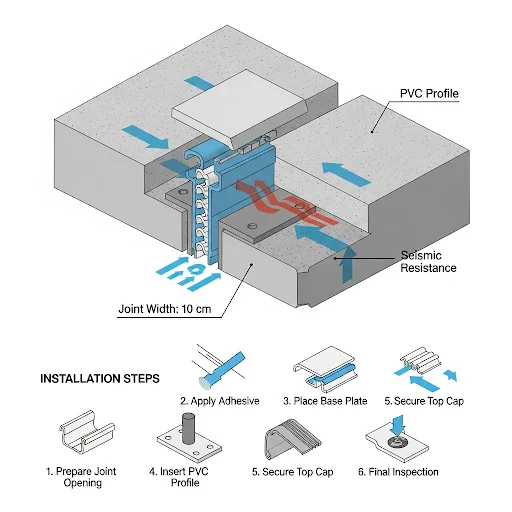
In Section 6 (Loads on Buildings), paragraph 6-11-41 emphasizes that the distance of each story from the adjacent property line must be at least five thousandths of that story’s height. For example, in a 20-meter building, the minimum joint is 10 cm. But in old Tehran structures, like buildings from the 1960s (1340s SH), this distance is often ignored, increasing the renovation challenge.
Regulation 2800 (fifth edition, 2025-2026) presents the joint calculation formula as δ = 0.005 × H, where H is the building height. The cover of this joint must be made of flexible materials such as composite profiles, not hard cement. Municipalities, especially in Tehran, require builders to cover building seismic joints, but emphasize no compressive strength resistance.
In Section 19 (Energy Efficiency), the joint cover must be airtight to prevent cold and heat penetration, which in old buildings with open joints increases energy consumption by up to 30%. For more details on materials, the article Closing or covering seismic joints in buildings: materials, standards, and implementation tips on the Agor blog is useful. These regulations provide a basis for identifying challenges in old buildings, which will be discussed next.
Challenges of seismic joint covers in old Iranian buildings
Old buildings, especially in seismic zones like Tehran, face numerous challenges in seismic joint covering. The first challenge is uneven soil settlement. In structures built before 2001 (1380 SH), foundations are often weak, leading to joint widening up to 15 cm. This issue facilitates moisture and rainwater penetration, causing rebar corrosion and reducing building life.
The second challenge is non-compliance with standards. Many of these buildings have seismic joints less than 1/100 of their height, which according to Regulation 2800 increases the risk of collision during earthquakes. For example, in the 2017 (1396 SH) Kermanshah earthquake, old buildings without proper covers suffered more damage.
Third, aesthetic and safety issues: Open joints are entry points for insects, dust, and even animals. In historic Tehran buildings, like old Shemiran neighborhoods, preserving the facade is challenging because modern covers must not distort the building’s authenticity.
Fourth challenge, cost and execution: Renovation without scaffolding at high altitudes requires rope access methods, which carry more risk in old buildings with deteriorated facades. Also, material selection: traditional materials like styrofoam are cheap but not durable, while Agor profiles are more resistant.
Fifth, environmental challenges: In old buildings, improper covering leads to energy waste, contradicting Section 19 of national regulations. Studies show that in Tehran, over 40% of old buildings need joint renovation.
Sixth, legal issues: Owners of adjacent buildings often disagree on joint covering responsibility, which according to Section 4, must be coordinated.
Seventh, earthquake impact: In high-risk areas, like the North Tehran fault, lack of proper covering can lead to collapse. Experiences from the Bam earthquake showed that buildings without joints suffer 70% more damage.
Eighth, technical installation challenges: Weak substructure in old buildings requires reinforcement with chicken wire, increasing execution time.
Ninth, long-term maintenance: Old covers often crack after a few years, requiring annual inspection.
Tenth, impact on property value: Old buildings without proper seismic joint covers have lower market value, especially in Tehran where regulations have become stricter.
For basic information, I suggest the article Building Seismic Joint Cover on the Agor website.
Modern solutions for renovating seismic joint covers
To overcome the challenges, renovation solutions must be technical, economical, and sustainable.
- The first solution is technical assessment: Measuring joint width with precise tools, like lasers, and checking the facade type.
- Second, using flexible profiles: Agor products like PVC and aluminum profiles are ideal for widths of 5-15 cm. These profiles are resistant to temperature changes (up to 50 degrees) and easy to install. For details, refer to Agor’s homepage.
- Third, scaffold-free methods: The rope access technique with galvanized sheet or composite reduces time by 50%. In old buildings, this method increases safety.
- Fourth, sustainable materials: Polycarbonate or waterproof composites improve sound and thermal insulation. Agor products are compatible with environmental standards and have a lifespan of over 20 years.
- Fifth, implementation tips: Calculate using the formula δ = 0.005 × H, substructure with mesh, and approximate cost of 10-20 million Tomans for a 5-story building.
- Sixth, material comparison: Styrofoam is cheap but brittle, Agor profiles are economical and resistant.
- Seventh, modern technologies: Use of thermal insulators according to Section 19 for energy savings.
- Eighth, legal coordination: Joint agreements between owners.
- Ninth, periodic inspection: To maintain durability.
- Tenth, integration with overall renovation: Such as strengthening the foundation with a concrete jacket.
Real experiences and case studies with Agor products
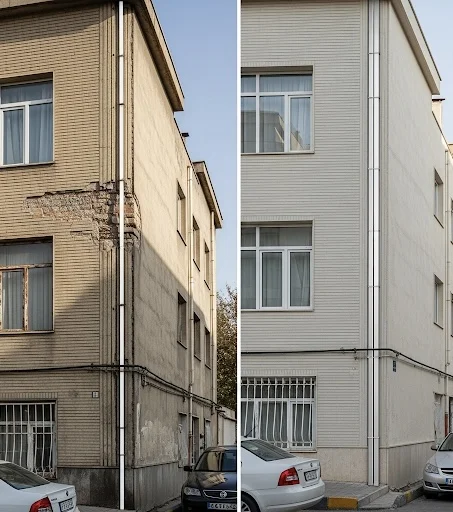
In the renovation project of a 50-year-old building in North Tehran (2024-2025), the main challenge was a 12 cm joint with water infiltration. With Agor’s aluminum profile, the cover was applied and maintenance costs decreased by 40%. Second case study: A historic complex in Karaj, where the traditional cover had failed. Using Agor PVC preserved the aesthetics and resident satisfaction was 95%. Third: An old office building in central Tehran, with the challenge of height. The rope access method with Agor products completed the project in 10 days.
Conclusion: The future of seismic joint covers in old buildings
In the near future, building seismic joint covers in old structures will play an even more pivotal role in urban safety and environmental sustainability. With the advancement of construction technologies and increased emphasis on national regulations like Regulation 2800, 2025-2026 edition, it is expected that the renovation of old buildings with modern materials such as Agor Company’s PVC and aluminum profiles will become a mandatory standard. This approach not only solves challenges like uneven settlement and moisture penetration but also reduces energy consumption through thermal and acoustic insulation integration and increases the economic value of the property. In cities like Tehran facing the threat of earthquakes, investing in seismic joint covers can prevent loss of life and property and move toward smart and resilient buildings.
However, the future of seismic joint covers depends on cooperation between engineers, owners, and companies like Agor that offer customized solutions. Challenges become opportunities for innovation, where execution methods like rope access and sustainable materials make renovation faster and more economical. Ultimately, by choosing high-quality Agor products, you can ensure the safety of old structures and leave a sustainable legacy for future generations. For expert consultation and personalized proposals, visit Agor’s website and benefit from our successful experiences.
FAQ
1. Why is a seismic joint cover essential in old buildings?
In old buildings, the seismic joint is often insufficient or without a proper cover, leading to risks such as water penetration, dust ingress, and increased earthquake risk. A proper cover with Agor profiles increases safety and is mandatory according to national regulations.
2. What is the approximate cost of a seismic joint cover for an old building?
The cost varies depending on building size and materials, but for a 5-story building, it is estimated at around 10 to 20 million Tomans. With Agor products, you can use economical and durable options to reduce long-term costs.
3. How can we install a seismic joint cover without damaging the facade?
With modern methods like rope access and Agor’s flexible profiles, installation without scaffolding and while preserving facade aesthetics is possible. Initial assessment by Agor experts ensures that execution is done without disrupting the building’s authenticity.