



Introduction: Why is seismic joint cover important?
In building design and construction, there are details that may seem small and unimportant at first glance, but in reality they can play a key role in structural safety, facade aesthetics, and even obtaining municipal completion certificates. One of these critical details is the issue of seismic joint covers. A seismic joint is a gap created between two adjacent buildings according to Iran’s seismic design regulations (Standard 2800).
The purpose of this gap is to prevent buildings from colliding and impacting each other during earthquakes or unwanted settlements. But if this joint itself is left uncovered, it creates serious problems: from rain and dust penetration to accumulation of birds and small animals, and even safety hazards. For this reason, municipalities are very strict about seismic joint covering when issuing building completion certificates. Without covering this gap with suitable and approved materials, obtaining a completion certificate is practically impossible.
In this comprehensive article, we will address all aspects of seismic joint covering: from municipal regulations and criteria to introducing materials and execution methods (scaffolding and rope access), execution details on roofs and facades, costs in 2025-2026, supervisor checklists, and common contractor mistakes. You can also refer to the article Building Seismic Joint Cover for more information.
Municipal requirements and completion certificates for seismic joint covers
Why is a completion certificate not issued without a seismic joint cover? One of the sensitive stages at the end of the construction process is obtaining a completion certificate from the municipality. The completion certificate is an approval indicating that the building has been constructed according to regulations and is ready for operation. But one of the things checked during the final municipal inspection is the condition of the seismic joint and how it is covered.
According to regulations, “The joint at the facade location must be covered with lightweight and suitable materials.” If this has not been done, the supervisor is obliged to report it, and the municipality can prevent the issuance of the completion certificate.
Municipalities have taken this requirement seriously for two reasons:
- Urban safety: An open joint can cause objects to fall or animals to gather.
- Urban aesthetics: A building’s facade without a joint cover looks incomplete and unattractive.
Municipality-approved materials
Municipalities generally accept lightweight and resistant materials. For example:
- Galvanized sheet (accepted in many cities)
- Aluminum or composite covers
- Specialized profiles with elastomeric rubber
Some contractors mistakenly use hard or heavy materials to cover the joint, which not only creates a hazard but is also rejected by the supervisor. We suggest reading the article The Importance of Seismic Joint Covers Against Earthquakes to better understand why this issue is critical for municipalities.
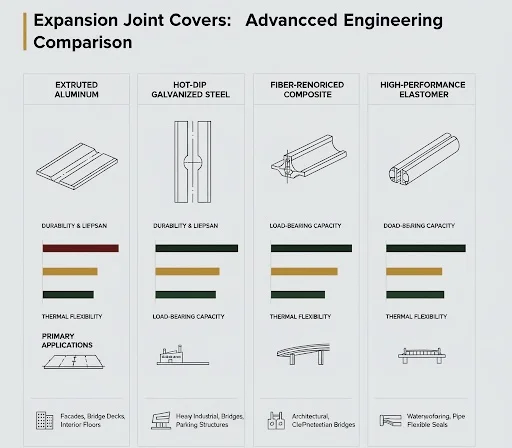
Types of seismic joint covers
1. Aluminum cover with elastomeric rubber
Aluminum covers with elastomeric strips are among the most advanced and reliable methods for covering seismic joints in modern buildings. These systems, due to their flexible design, allow relative movement between two structures and do not break or tear against temperature changes and earthquakes. Another important feature is their lightweight and corrosion resistance, meaning they have a long lifespan even in humid or polluted weather conditions.
Additionally, the appearance of these types of covers is very clean and uniform, making them an ideal choice for urban projects where facade aesthetics are very important. In Agor products, the S, M, T, E, and O series are designed exactly with this standard, so that in addition to complying with municipal regulations, the employer and supervisor can be confident about safety and quality.
2. Galvanized sheet
Galvanized sheet is one of the most common and at the same time most economical options for seismic joint covering. This type of cover is chosen by many contractors for medium and large projects due to its reasonable price and availability. However, its execution must be completely principled, because if care is not taken, there is a possibility of rain and moisture penetrating into the joint, which can cause structural decay or dampness in adjacent walls.
The most important point in using galvanized sheet is observing sealing details and proper connection to the facade so that the joint does not become a weak point in the building. In projects where the employer is looking for a cost-effective solution but at the same time wants the municipal standards for the completion certificate to be met, this method remains very popular.
3. Composite and PVC
Covers made of composite or PVC are mostly used for projects that need a lightweight and quick cover. These materials are usually very light and easy to install, but it should be noted that their mechanical resistance is lower than aluminum or galvanized sheet. Therefore, they are not recommended for luxury projects or high-rise buildings. However, for small residential buildings or projects with budget constraints, they can be an efficient option. Of course, the aesthetics of the facade in this method depend heavily on the quality of the installer’s work, and if sufficient care is not taken, the appearance will look poor.
For a more complete understanding of all options, see the article Comprehensive Review of Seismic Joint Cover Types.
Execution methods: Scaffolding or rope access?
Cover installation with scaffolding
Using scaffolding is one of the most traditional methods for installing seismic joint covers on building facades. In this method, the execution team can access all parts of the facade simultaneously and perform the work with greater precision. The big advantage of scaffolding is that in large projects, it allows simultaneous execution of other facade operations such as stone or glass installation.
However, using scaffolding has its own disadvantages: higher cost, more time for installation and dismantling, and causing disturbance to residents or passersby are among the common problems. For this reason, in recent years, the use of scaffolding for seismic joint covering has decreased except in projects that require extensive work on the facade.
Cover installation with rope access (without scaffolding)
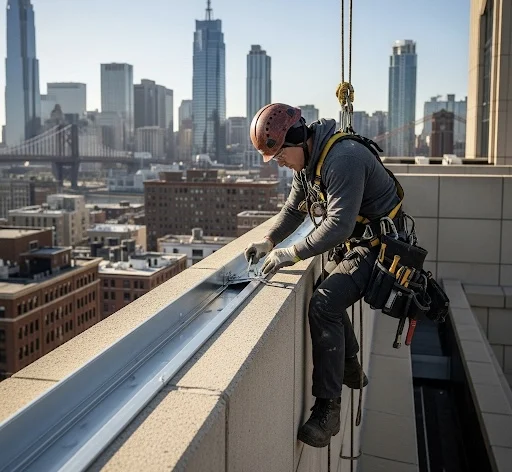
The rope access method, or working at height without scaffolding, is one of the modern and very popular methods in recent years. In this method, trained technicians, using full safety equipment such as ropes and harnesses, move directly on the facade and perform the installation of the seismic joint cover. The advantages of this method are high speed, lower cost, and not causing disturbance to the surroundings. Especially in urban high-rise buildings, working with rope access will be much more efficient than scaffolding.
Of course, this method requires a completely professional and licensed team, as the slightest mistake can be dangerous. Therefore, choosing a reputable contractor for installing the cover with rope access is very important.
Execution details in different parts of the building
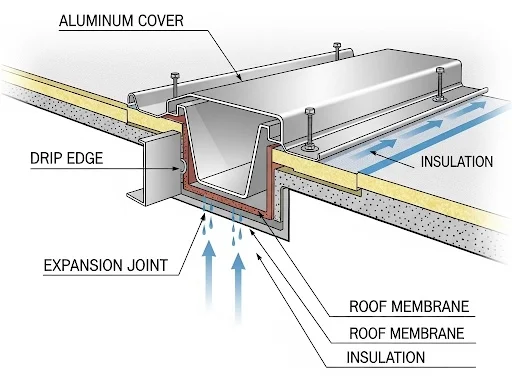
- Roof joint: At the highest part of the building, the roof joint requires a cover that, in addition to aesthetics, has the ability to resist rain and snow penetration. Using an aluminum cover with a drip edge is the best choice. In Agor O Series products, these types of covers are offered with special design to allow complete sealing and relative movement between the two structures.
- Facade lateral joint: In these sections, a cover is needed that is lightweight and at the same time can cover the lateral movement of the structures. Lightweight aluminum or composite profiles are usually the best option. Precise and uniform execution of these profiles keeps the building facade orderly and beautiful.
- Service and utility spaces: In sections such as engine rooms, parking lots, or industrial spaces, a more resistant cover is needed. For this reason, Agor M Series products are recommended, which have high durability and are very suitable for high-traffic environments or those under mechanical pressure.
Cost of seismic joint cover in 2025-2026
Estimating the cost of installing seismic joint covers has always been one of the main concerns of employers and contractors. This cost depends on several factors and a fixed number cannot be stated for all projects. In 2024-2025, the cost of installing seismic joint covers in Tehran ranged from 300,000 to 700,000 Tomans per linear meter. But due to the increase in material prices and wages, it is predicted that in 2025-2026, this figure will be between 400,000 and 1,000,000 Tomans per linear meter.
Factors affecting the price include:
- Joint width: The greater the distance between buildings, the more complex the cover type and the higher the cost.
- Building height: In high-rise projects, the work is more difficult and requires more expertise.
- Type of selected material: Using aluminum or elastomeric profiles will be more expensive than galvanized sheet or PVC.
- Execution method (scaffolding or rope access): Scaffolding costs more than rope access.
- Total project area: The longer the joint length, the higher the total cost, but contractors usually offer discounts for large areas.
Common contractor mistakes
Many contractors, due to lack of experience or to reduce costs, make mistakes that ultimately lead to the project being rejected by the supervisor or causing future problems for the building. The most common mistakes include the following:
- Closing the joint with rigid and immovable materials: This is against regulations and will be dangerous during an earthquake.
- Non-principled installation without sealing: As a result, water and moisture penetration damages the facade and structure.
- Choosing a heavy cover: Heavy covers pose a risk of falling in the long term, and the municipality does not approve them either.
- Ignoring facade aesthetics: The city’s facade should be homogeneous and beautiful; inappropriate covers reduce the building’s visual quality.
Final checklist for the supervisor
Before approving the completion certificate, the project supervisor must carefully inspect the seismic joint cover. The most important items in the checklist are:
- Is the joint width according to the calculations of Regulation 2800?
- Does the selected cover type allow relative movement between the two structures?
- Has sealing been done completely and to standard?
- Does the color and material of the cover comply with urban aesthetics criteria?
Conclusion
Seismic joint covering is not just a simple execution detail, but one of the technical and legal requirements in construction, without which obtaining a municipal completion certificate will not be possible. Choosing the right materials, using a specialized execution team, and carefully following details will put your building at a high level of safety and beauty. To choose the right system, you can refer to Agor’s homepage and select the best option from our specialized products.
FAQ
1. Is a seismic joint cover mandatory for the completion certificate?
Yes, without a proper cover, a completion certificate will not be issued.
2. What is the best material for a seismic joint cover?
Aluminum profiles with elastomeric rubber are the best option.
3. How much does it cost to install a seismic joint cover in 2025-2026?
Depending on the type of material, execution method, and project height, it will be between 400,000 and 1,000,000 Tomans per linear meter.