

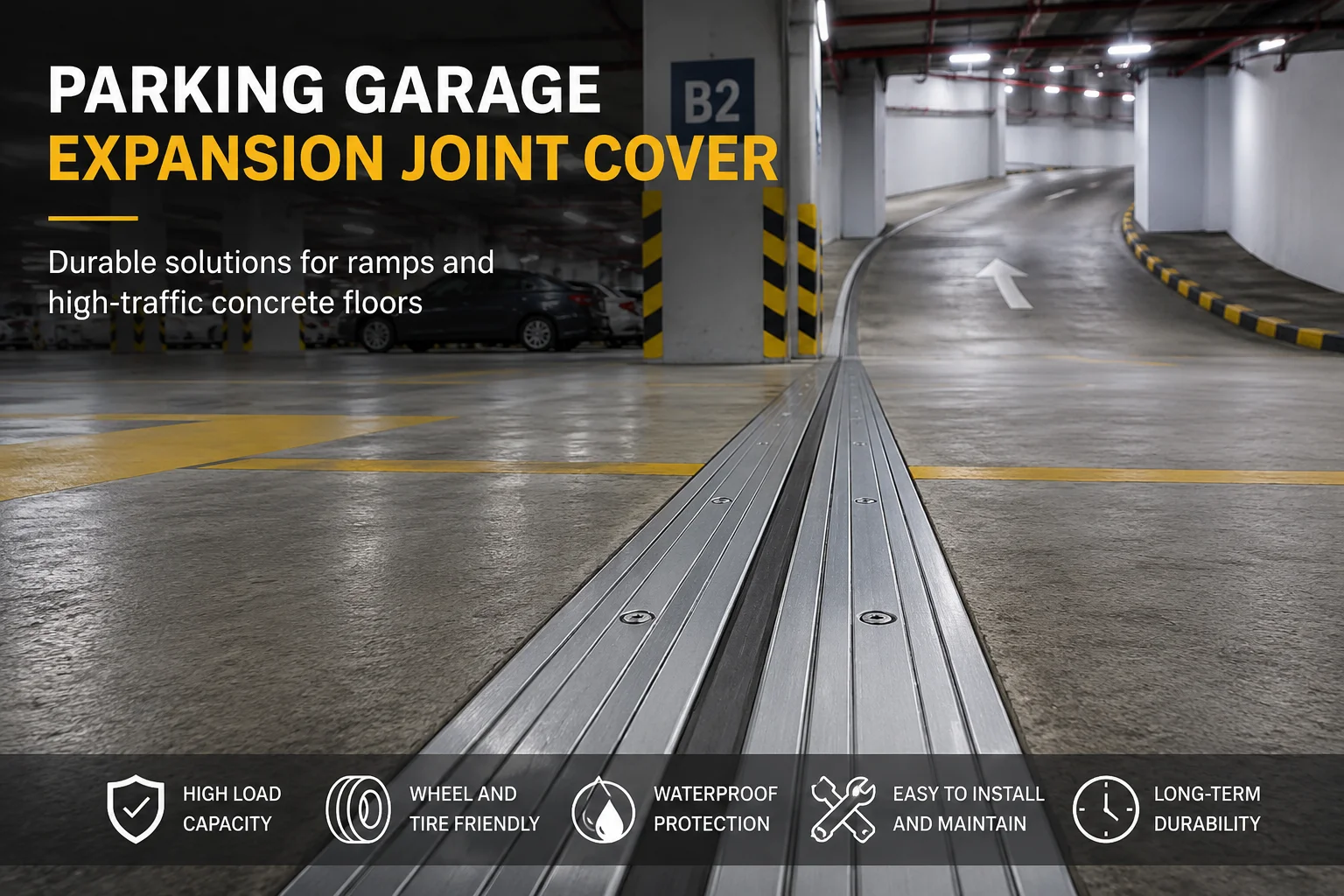
Parking areas are among the parts of a building that are directly exposed to pressure, abrasion, and continuous vehicle traffic. If expansion joints in these areas are left without a standard protective system, the risk of water penetration, dust accumulation, damage to floor edges, and disturbing noise increases. For this reason, selecting a parking expansion joint cover is not merely an aesthetic decision; it is an important part of project safety, durability, and execution quality.
To learn more about AGOR’s general solutions in this field, you can visit the expansion joint cover page.
Why Are Expansion Joints More Sensitive in Parking Areas?
Expansion joints in parking floors, ramps, entrance and exit routes, and other high-traffic surfaces are exposed to greater pressure than those in many indoor spaces. Vehicle movement, braking, tire rotation, floor washing, and temperature fluctuations mean that the selected material must offer high mechanical resistance and long-term durability. If the chosen cover is suitable only for light-duty or decorative spaces, it may loosen, deform, or break within a short period.
Parking areas are also frequently exposed to moisture, oil, dirt, dust, and cleaning chemicals. Therefore, the selected system should not only withstand vehicle loads but also provide effective waterproofing and easy maintenance.
Installation of a parking expansion joint cover on a concrete ramp and high-traffic floor
Key Features of a Suitable Parking Joint Cover
A standard parking joint cover should have several essential characteristics, including resistance to vehicle wheel pressure, prevention of tire or footwear trapping, a safe walking and driving surface, compatibility with the floor finish, and the ability to accommodate controlled joint movement. These features become even more important in projects with busy ramps or entrances.
The selection process should be based on the joint width, flooring type, traffic volume, installation location, environmental moisture, and the project’s waterproofing requirements. To better understand different systems and their applications, you can also read the article on types of expansion joint covers.
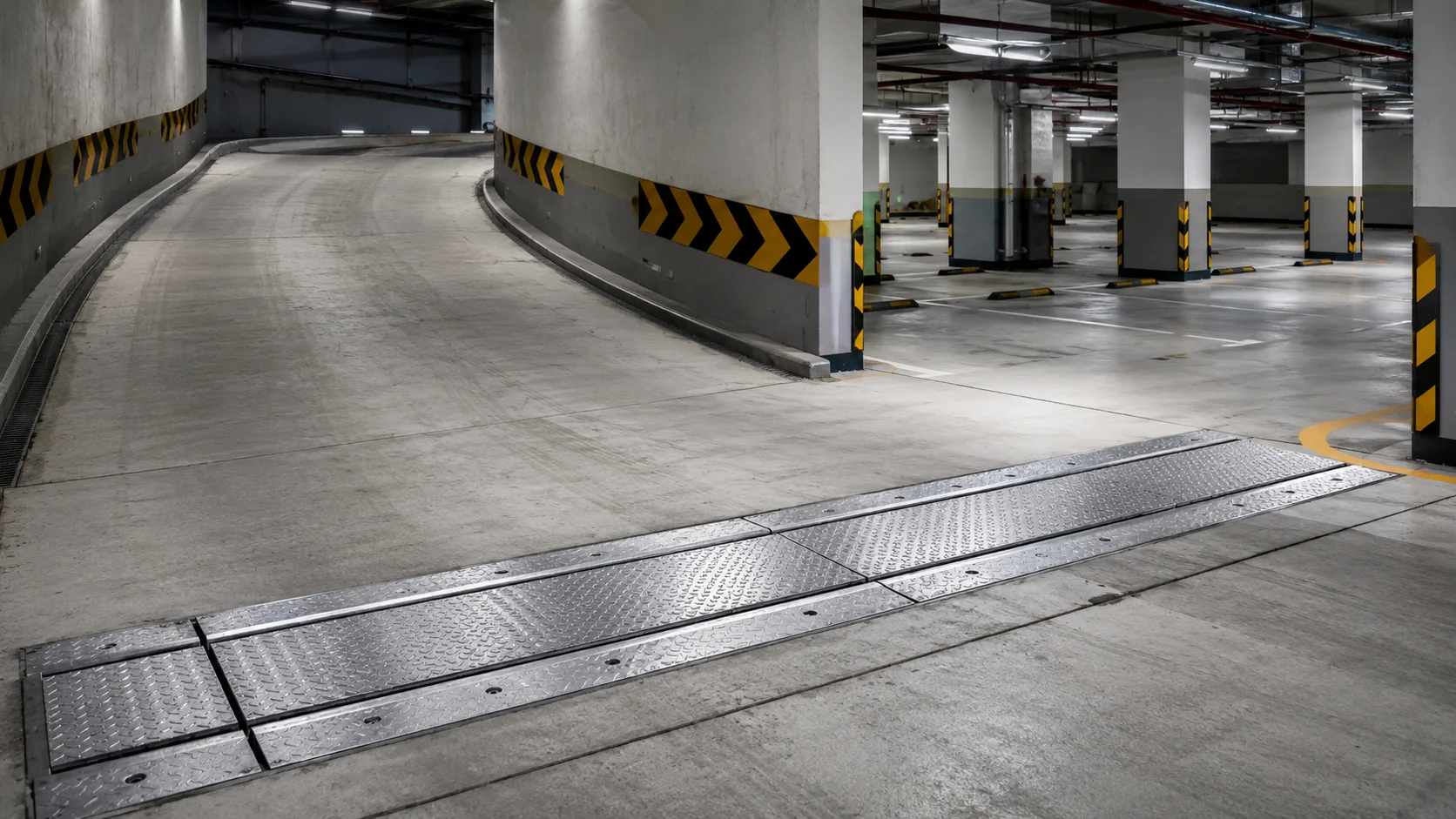
Table: Selecting the Right Cover Based on the Installation Area
| Installation area in the parking facility | Main challenge | Recommended cover feature | Installation note |
|---|---|---|---|
| Entrance and exit ramps | High pressure, braking, and abrasion | Heavy-duty profile with appropriate load capacity | The system must be installed completely flush with the floor |
| Parking floor levels | Continuous vehicle traffic | Material resistant to impact and vibration | The joint width must be checked before ordering |
| Outdoor parking areas | Rain, sunlight, and temperature changes | Moisture- and corrosion-resistant cover | Proper edge waterproofing is essential |
| Commercial parking facilities | Heavy and continuous traffic | Durable system with easy maintenance | Periodic servicing or component replacement should be possible |
| Pedestrian routes inside parking areas | Pedestrian safety and appearance | Smooth surface without sharp edges or level differences | Compatibility with the final flooring is important |
Close-up view of a metal parking expansion joint cover securely fixed to a concrete floor
Steps for Proper Selection and Installation
The first step is to measure the joint width accurately and inspect the condition of the floor. In many projects, the main problem does not begin with the product itself, but with incorrect measurements, weak substrate preparation, or improper installation. Before making the final selection, it is necessary to determine where the joint is located, how much structural movement is expected, and which type of cover is most compatible with the parking floor.
The second step is to inspect the substrate. Both sides of the joint must be clean, level, strong, and ready for installation. Cracks, hollow areas, improper slopes, or weak materials can reduce the service life of the system. For more information on this stage, you can refer to the article on substrate preparation and installation of expansion joint cover profiles.
In the third stage, the selected product must be suitable for the actual use of the parking area. A parking expansion joint cover should not be chosen only according to appearance or price. If the system fails, the cost of repairing the floor, interrupting facility operations, and replacing damaged components may be much higher than the initial cost of selecting a standard product.
Inspection and installation of a parking expansion joint cover by a technical team on a concrete floor
Common Mistakes When Selecting Parking Joint Covers
One of the most common mistakes is using light-duty covers in high-traffic routes. Some products are suitable for low-traffic indoor areas but cannot withstand the continuous passage of vehicles. Another mistake is ignoring waterproofing. In parking facilities that are regularly washed or located on underground levels, water penetration into the joint can gradually damage the floor, create unpleasant odors, and affect surrounding materials.
Other common mistakes include installing the cover at an uneven level,using unsuitable screws or connections, choosing materials that are incompatible with environmental conditions, and neglecting periodic maintenance. For more general information about closing and protecting joints, the article on closing or covering expansion joints in buildings can also be useful.

Periodic Maintenance and Inspection
Even the highest-quality system cannot maintain its long-term performance without regular inspection. In parking areas, the condition of screws, edges, waterproofing components, possible deformation, and vehicle-related noise should be checked periodically. If the joint is located on a ramp or at a main entrance, inspections should be carried out more frequently.
In high-traffic projects, the parking expansion joint cover should be designed so that damaged components can be serviced or replaced without extensive floor demolition. This is especially important in shopping centers, office buildings, hospitals, and large residential complexes.
Conclusion
Parking areas are simultaneously exposed to mechanical pressure, moisture, dirt, and continuous traffic. Therefore, the selection of a suitable joint cover must be based on engineering considerations rather than appearance or initial cost alone. A parking expansion joint cover performs effectively when its material, substrate preparation, waterproofing, and installation method are fully compatible with the actual project conditions.
When designing, renovating, or constructing a parking facility, carefully assessing the joint width, traffic type, moisture conditions, and installation details can prevent future repair costs. Proper selection not only improves floor durability but also increases the safety of both vehicles and pedestrians.