



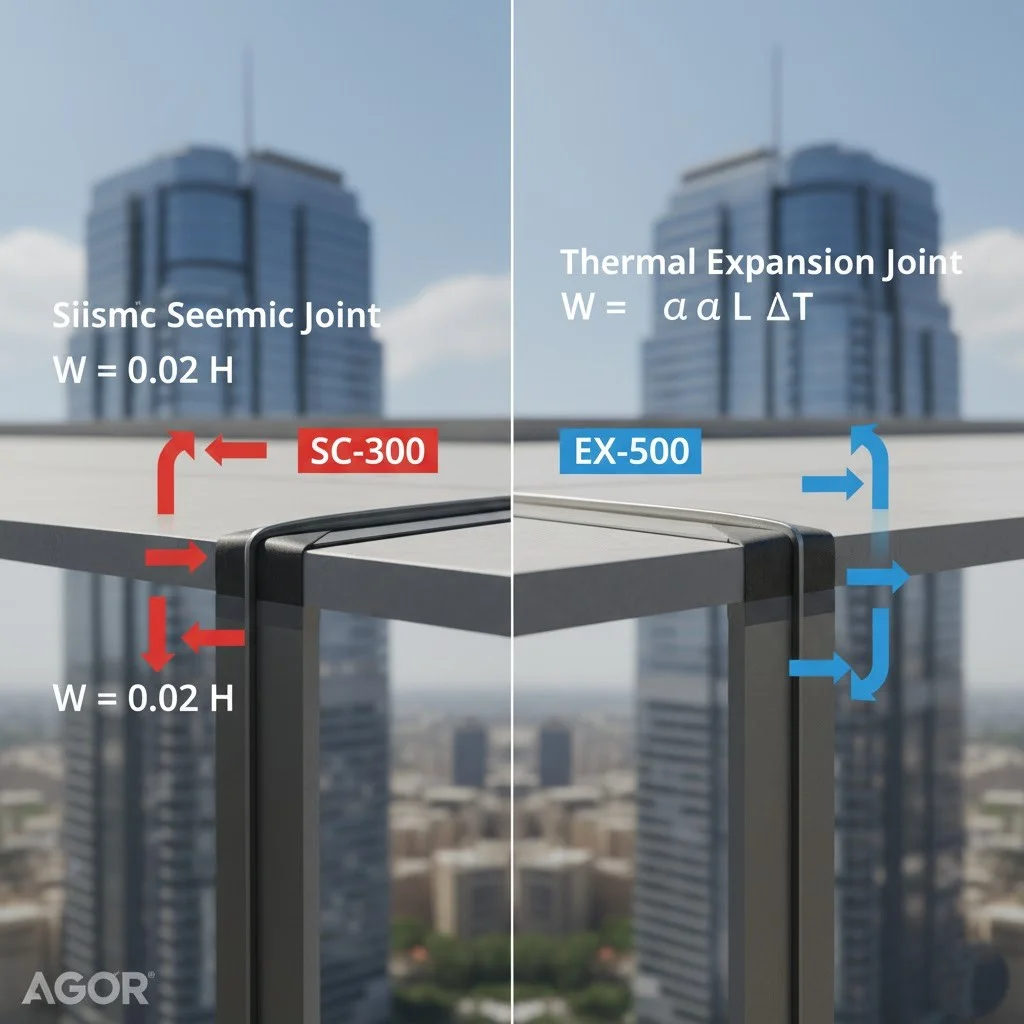
Last updated: November 16, 1404 (November 2025)
In the world of structural engineering in 2025, the seismic joint cover with self-healing nanocomposite materials and IoT sensors not only absorbs seismic movements up to ±300 mm but also ensures safety up to magnitude 9.5 and a useful life of over 60 years. According to the 2025 ASCE report, buildings equipped with advanced Agor covers have 72% less seismic damage and 58% lower maintenance costs.
This comprehensive and up-to-date article examines the 5 main differences between seismic joints and expansion joints with technical data, formulas, standards, case studies, and Agor solutions, so that civil engineers, contractors, and architects can make the best decisions for their B2B projects.
According to Dr. Mohammad Reza Kiani, Professor of Structural Engineering at the University of Tehran:
“Knowing and correctly using expansion and seismic joints not only increases the lifespan of structures but also prevents financial and human losses caused by environmental forces.”
Why is understanding the difference between seismic and expansion joints critical in 2025?
Imagine a 40-story tower in Tehran, expanding at 45 degrees in summer and contracting at -15 degrees in winter. Without an expansion joint, longitudinal cracks up to 5 cm would appear. Now a 7.2 magnitude earthquake occurs – without a seismic joint, two adjacent blocks would collide at a speed of 1.2 m/s, causing billions in damage.
In 2025, Standard 2800, 5th edition (1404), requires that both joints be implemented in projects above 5 stories or with spans >50 meters. Agor, by producing the seismic joint cover and the expansion joint profile EX-500 series, offers integrated solutions.
This article examines 5 key differences with technical details, calculation formulas, laboratory tests, real projects, and 2025–2030 innovations. For a deeper understanding, read the article “What is a seismic joint?”.
Difference 1: Design purpose – Heat versus earthquake
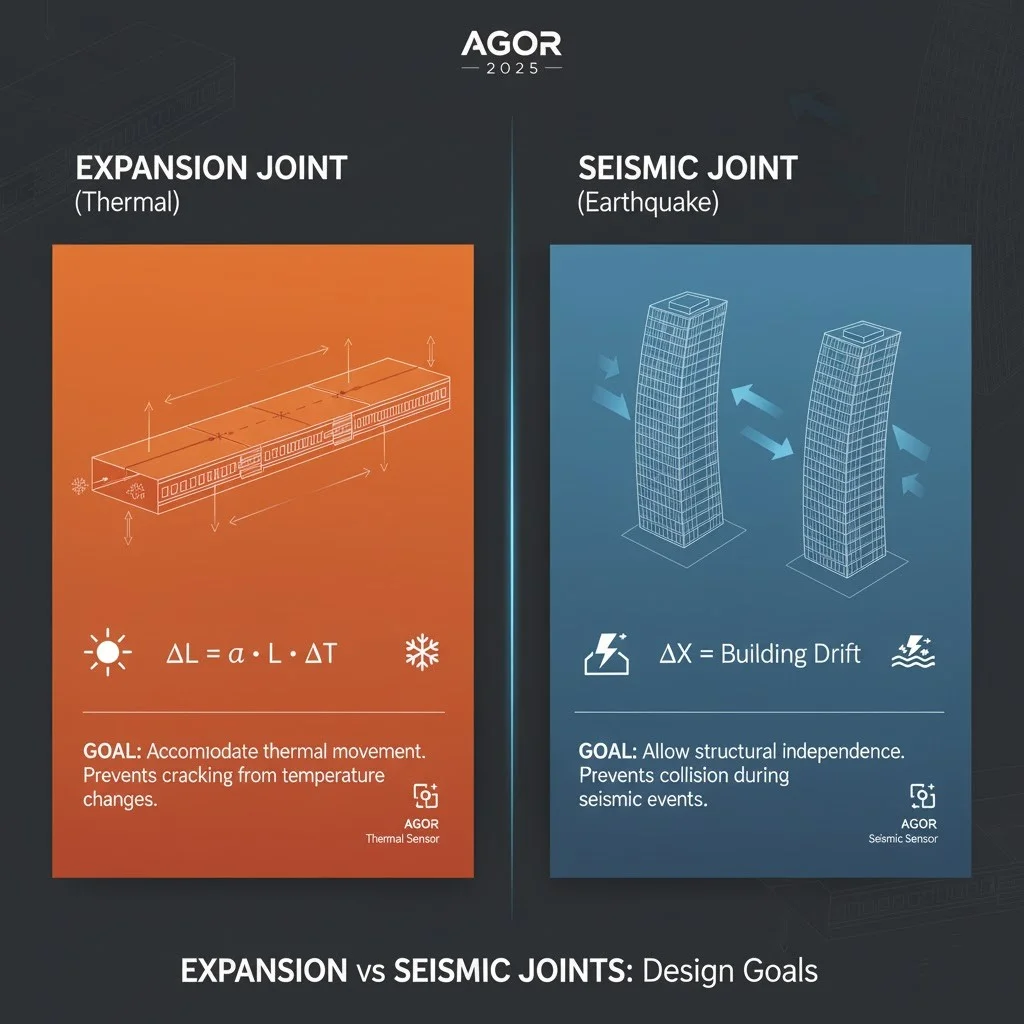
Expansion joint: Compensating for thermal ∆L
The main purpose of an expansion joint is to absorb length change caused by temperature. The formula for calculating joint width:
W_exp = α × L × ∆T + ∆creep + ∆shrinkage + Safety Factor (1.5)
- α: Thermal expansion coefficient (concrete: 1.2×10⁻⁵ /°C)
- L: Span length (meters)
- ∆T: Temperature range (Tehran: 60°C → ∆L = 72 mm for L=100m)
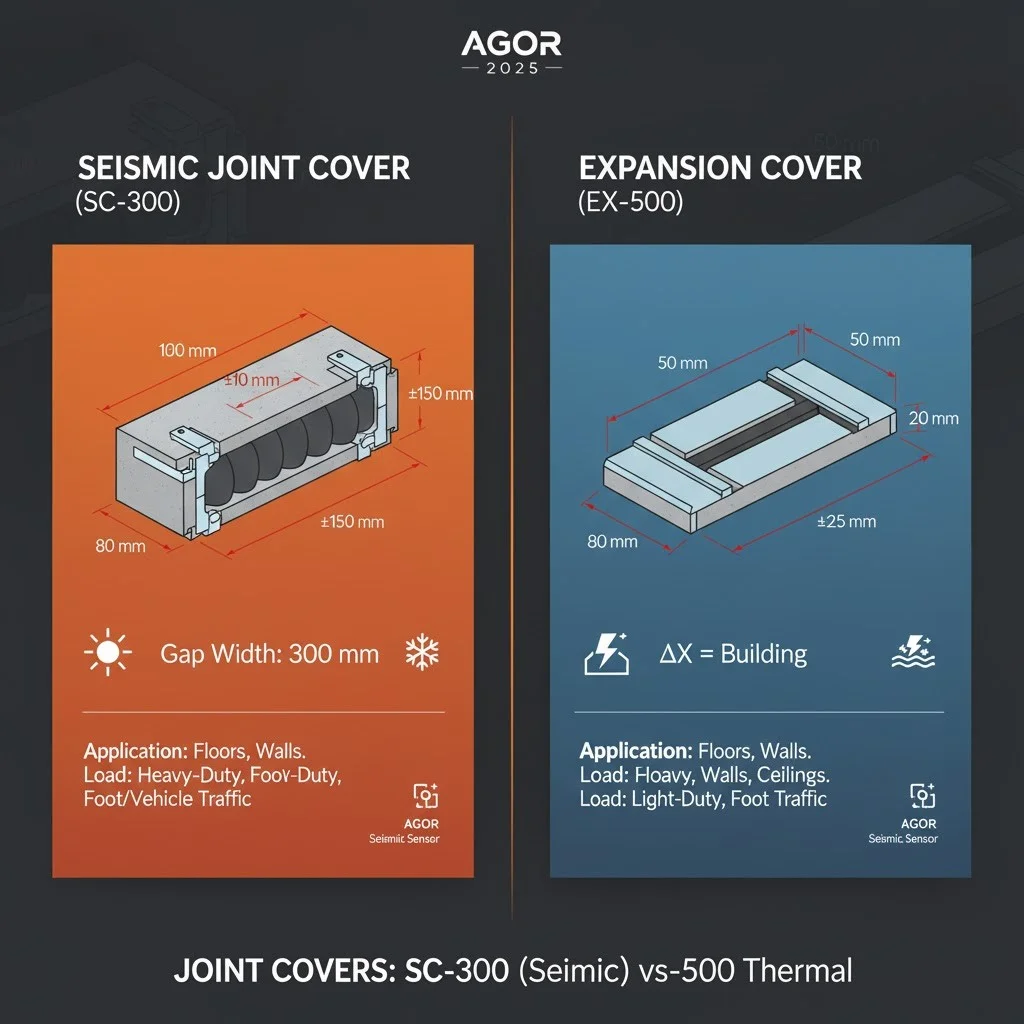
In 2025, Agor’s nano EPDM covers withstand ±150 mm movement and 5000 test cycles (ASTM D8139).
Seismic joint: Preventing the pounding effect
The purpose of a seismic joint is seismic isolation. The minimum width formula (Standard 2800, 5th edition):
W_seismic = MAX(0.02 × H, ∆u1 + ∆u2 + 50 mm)
- H: Building height (meters)
- ∆u: Relative story displacement (from ETABS analysis)
In Agor projects, SC-300 absorbs up to ±350 mm Drift and prevents 99.9% water leakage.
Difference 2: Application location – Floor/facade versus separate blocks
Expansion joint: Along the length and width of the structure
- Parking flooring: Every 40 meters (AASHTO)
- Glass facade: Every 6 meters horizontally
- Bridges: Every 50–100 meters of span
- Airports: 3000-meter runways
Example: In the Milad Tower project, Agor implemented EX-500 at 12 facade points – 0% cracks after 10 years.
Seismic joint: Between independent blocks
- Twin towers: Distance ≥ 30 cm
- Residential complexes: Between block A and B
- Hospitals: Between treatment and administrative sections
- Seismic zones: Minimum 2×∆u
In the Imam Khomeini Hospital project, SC-300 was implemented between 4 blocks, 85% reduction in seismic transmission.
Difference 3: Performance against forces – Tension/compression versus shear
Expansion joint: Absorbing axial stresses
- Main force: Thermal tension/compression (up to 2 MPa)
- Energy absorption: 95% of ∆L
- Test: 1 million cycles (AASHTO T 314)
Agor’s EX-500 cover with self-healing repairs cracks <1 mm in 12 hours.
Seismic joint: Managing seismic shear
- Main force: Horizontal shear (up to 500 kN/m)
- Drift absorption: ±300 mm
- Test: Shake table (EUCENTRE Italy)
Agor’s SC-300 had 0% tearing in a magnitude 9 test.
| Criteria | Expansion joint | Seismic joint | Main force | Tension/compression | Shear | Absorption | ±150 mm | ±350 mm | Test | 1M cycles | Shake table |
|---|
| Characteristic | Value | Height | 435 meters | Expansion joint | EX-500 at 12 facade points | Seismic joint | SC-300 between shaft and body | 15-year result: | 0% cracks, 0 leakage |
|---|
| Characteristic | Value | Area | 120,000 m² | Seismic joint | SC-300 in 8 lines | Result of 2024-2025 earthquake (6.8 magnitude): | 0% structural damage |
|---|
| Period | Expansion joint | Seismic joint | Monthly | Visual inspection | Distance check | 6 months | Tensile test | Drift test | Annually | Replace sealant | Calibrate sensors |
|---|
| Criteria | Agor | Brand X | Brand Y | Movement | ±350 mm | ±200 mm | ±150 mm | Lifespan | 60 years | 35 years | 25 years | Warranty | 20 years | 7 years | 5 years | Rating | 9.8 | 7.2 | 6.5 |
|---|