



In Iran’s conditions, where over 90% of the country’s area is located in high earthquake risk zones, seismic joint covers (Expansion Joint Cover or Seismic Joint Cover) are one of the vital components in the design and construction of safe and durable buildings. This system not only prevents adjacent structures from colliding during an earthquake but also controls the penetration of water, dust, sound, and changes in facade appearance. Considering the severe fluctuations in raw material prices (aluminum, EPDM elastomer, stainless steel) in recent years and the direct effect of exchange rates on imported products, many supervising engineers, contractors, and employers in the year 1405 (2026-2027) are seeking accurate and up-to-date information on the price of seismic joint covers.
In this comprehensive article, we will scientifically and technically examine the topic, factors affecting the price in the current year, a comparison of Iranian brands (including Agor’s specialized products) with imported samples, selection and installation guides, implementation tips, and maintenance, so that you can make an informed decision for your projects.
Scientific definition and importance of seismic joint covers
A seismic joint cover is an engineered system that covers the empty space (isolation joint) between two parts of a building or between a building and an adjacent structure, without creating significant force transfer between them. This joint is designed to absorb relative displacements caused by earthquakes, thermal expansion and contraction, differential settlements, and even strong winds.
From a scientific perspective:
- Movement Capability: The cover must be able to withstand at least ±25 to ±100 mm of movement (depending on the model) without failure or leakage.
- Insulation: It must be water-tight, smoke-tight, and in some cases fire-rated.
- Environmental Durability: Resistance to UV radiation, thermal cycles (-40 to +120 °C), chemicals, and mechanical abrasion.
Failure to use a proper cover can lead to:
- Rainwater penetration and cracking in the facade and inside the structure
- Damage to thermal and acoustic insulation
- Reduced aesthetic appeal of luxury projects
- Increased repair and maintenance costs after an earthquake
Calculation of seismic joint width according to Standard 2800 (4th edition)
According to Iran’s Standard 2800:
Buildings of 8 stories or less:
Minimum joint width = 0.005 × building height from base level (in meters) Example: 20-meter building → minimum 10 cm seismic joint
Buildings over 8 stories or with high importance
- Joint width = √(Δ₁² + Δ₂²) where Δ₁ and Δ₂ are the nonlinear lateral displacements of each building at the desired story (considering the P-Δ effect).
- Overall minimum width: usually 8 to 20 cm (depending on height and type of structural system)
This calculation directly affects the selection of the cover model (and consequently the price); because covers with higher displacement are more expensive.
Applications and technical benefits in civil projects
Seismic joint covers are used in various sections:
- Exterior facades: Maintaining beauty and preventing water penetration in residential and commercial towers
- Parking floors and ramps: Withstanding heavy loads (up to 40 tons) and continuous traffic
- Roofs and terraces: Covering thermal expansion joints in large spaces
- Industrial projects: Factories, hospitals, data centers (requiring Fire-rated and Chemical-resistant)
- Luxury interior spaces: Lobbies and corridors of hotels and office complexes
Key benefits:
-
- Increased seismic safety (preventing pounding)
- Reduction of post-earthquake repair costs by up to 70%
- Improved thermal and acoustic performance (R-value up to 2.8 in hybrid models)
- Possibility of installation without disrupting usage (rope access method or flush installation)
- Increased project sales value due to facade quality
Factors affecting the price of seismic joint covers in the year 1405 (2026-2027)
The price of seismic joint covers in 1405 is influenced by the following factors:
- Base material type
- Anodized or powder-coated aluminum → cheaper
- Stainless steel 304/316 → more expensive (high corrosion resistance)
- EPDM or silicone elastomer → main determinant of durability
- Allowable movement amount ±25 mm → economical ±50 to ±100 mm → 40–80% more expensive
- Type of usage and loading Heavy traffic floor → higher price (reinforced profile and rubber)
- Installation method Surface-mounted → cheaper Flush or recessed → more expensive (requires precise design)
- Exchange rate and raw material fluctuations Imported aluminum and EPDM → directly affected by the dollar
- Order volume and services Large projects → significant discount + free installation services
- Brand and after-sales service Iranian brands with local support → more economical
Approximate market price (per linear meter – year 1405 – requires accurate inquiry):
- Simple facade models: 1,800,000 – 3,200,000 Tomans
- Traffic floor models: 3,500,000 – 7,000,000 Tomans
- Advanced seismic models: 5,000,000 – 12,000,000 Tomans
Introduction of AGOR specialized products
Agor, as a domestic manufacturer of movement profiles and seismic joint covers, offers products designed based on Standard 2800 and EN standards.
S Series – Facade and external wall cover
- Movement: ±50 mm
- Material: Aluminum 6063 + UV-resistant EPDM
- Thermal resistance: -40 to +120 °C
- Color options: Anodized, electrostatic powder coating
F Series – Traffic floor and parking cover
- Load capacity: up to 40 tons (tested)
- Material: Heavy aluminum + abrasion-resistant rubber
- Installation: Surface-mounted or recessed with internal drainage
- 100% waterproof
P Series – Luxury interior movement profile
- Minimalist design and paintable
- Movement: ±30 mm
- Suitable for lobbies and commercial spaces
FR Series – Fire Rated model
- Fire resistance: up to 120 minutes (UL or BS)
- Suitable for hospitals and data centers
For complete specifications, visit Agor products page.
Comprehensive comparison of Iranian and imported brands (1405)
| Feature | Iranian Brand (AGORESHTAD and similar) | Imported Brand (European/Chinese) | Main Advantage | Approximate price (Tomans/meter) | 1,800,000 – 6,500,000 | 3,500,000 – 12,000,000 | Iranian 30–60% cheaper | Material quality | Excellent (internal testing + first-grade EPDM) | Excellent to very good | Similar in practical application | Delivery time | 7–21 days | 45–120 days | Iranian much faster | After-sales service | Complete (installation, warranty, field consultation) | Limited (often poor agency) | Iranian superior | UV and thermal resistance | Very good (Iranian/Turkish EPDM) | Excellent | Close to each other | Compliance with Standard 2800 | Complete (local design) | Good (needs adaptation) | Iranian more suitable for Iran | Local technical support | Excellent | Medium to poor | Iranian superior |
|---|
Comparison conclusion: In 1405, considering exchange costs and delivery time, Iranian products like Agor series are the optimal choice for most projects; except in special cases where a very luxurious appearance is a priority.
Step-by-step selection and installation guide
- Calculate the joint width (with a structural engineer)
- Determine the type of usage (facade / floor / roof / fire-rated)
- Check environmental conditions (UV, humidity, traffic load)
- Select the model (movement, material)
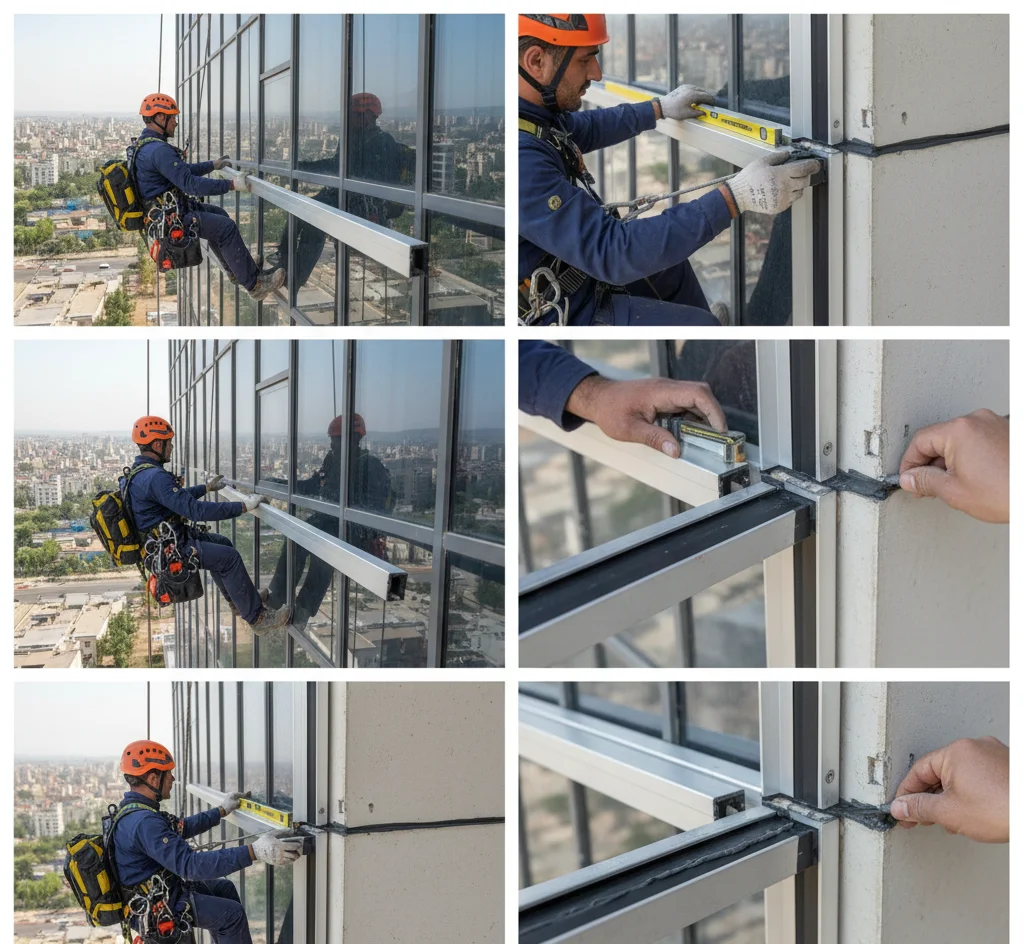
- Installation:
- Thorough surface cleaning
- Precise measurement and 45-degree cutting at corners
- Installation with roll-plug screws or structural adhesive (Sika or similar)
- Final sealing with UV-resistant polyurethane silicone
- Manual movement test
Recommendation: Installation by a specialized team to prevent leakage and misalignment.
Implementation challenges and long-term maintenance tips
Common challenges:
- Water penetration due to incorrect installation → Solution: Use internal drainage and hybrid silicone
- Color change under UV → Solution: EPDM with UV filter or surface anodizing
- Damage during rope access installation → Solution: Two-stage quality control
- Differential settlement → Solution: High-movement cover
Maintenance:
- Visual inspection every 6 months
- Cleaning with water and non-acidic detergent
- Check elastomer every 12–18 months
- Replace damaged parts (usually only the rubber)
Conclusion
Seismic joint covers are a technical and safety element, and choosing them correctly can make a significant difference in the durability, beauty, and future costs of the project. In 1405, considering the economic conditions and the high quality of domestic production, Agor’s specialized products offer a very good balance between price, seismic performance, durability, and after-sales service.
For an accurate price inquiry for seismic joint covers in 1405 according to your project, to receive the complete technical catalog, or for a free on-site consultation, contact Agor’s technical experts now or visit our contact page. The safety and quality of your building are our commitment.
FAQ
1. How much is the price of a seismic joint cover in the year 1405 approximately?
Depending on the model and usage, it varies from about 1.8 to 12 million Tomans per linear meter. Inquire for the exact price for your project.
2. Why are Iranian products usually cheaper than imported ones?
The absence of customs costs, shipping, and exchange rates leads to a 30–60% price reduction; while the quality of materials and after-sales service is often equal or better.
3. How is the seismic joint width calculated?
For buildings up to 8 stories: 0.005 × height; for high-rises: √(Δ₁² + Δ₂²) according to Standard 2800.
4. Does a seismic joint cover need maintenance?
Yes; periodic inspection every 6–12 months is recommended to check sealing, elastomer, and connections.
5. Which model is more suitable for parking lots?
Traffic floor models with high load capacity (like Agor’s F series) that are waterproof and abrasion-resistant.