

Introduction
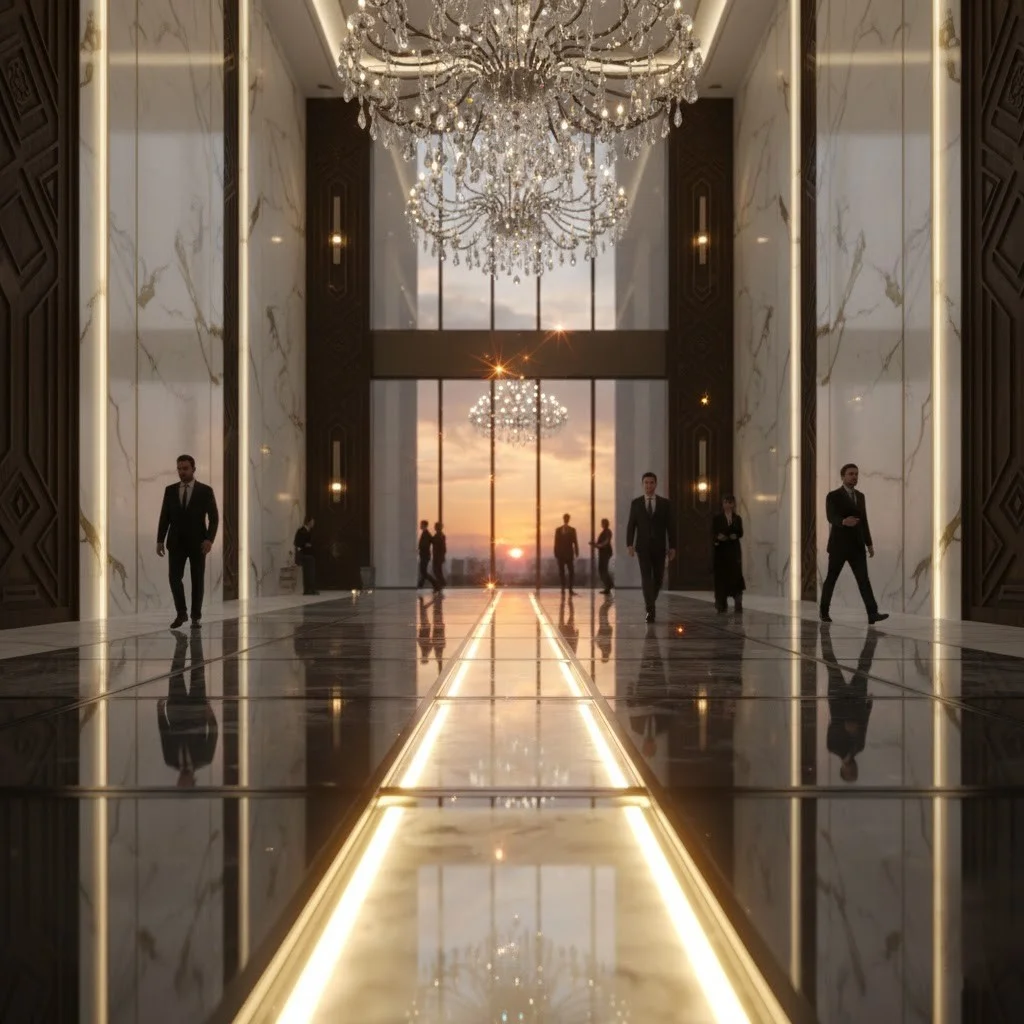
The lobby is the main showcase of any luxury tower. Employers and architects today seek completely transparent floors and walls with no visual interruption, but the mandatory seismic joint creates a serious challenge to this goal.
In recent years, the transparent Agor seismic joint cover has become one of the most in-demand products in projects exceeding 50 billion Tomans. These systems not only maintain the seismic performance of the structure but also ensure minimalist beauty and maximum light transmission.
In this comprehensive article, we will technically address the following:
- Precise definition and standards of transparent seismic joint covers
- In-depth comparison of multi-wall polycarbonate versus tempered laminated glass
- Introduction of Agor Ehtad specialized models
- Implementation tips, challenges, and real solutions
- Case study of projects executed in Tehran
What is a transparent seismic joint and what standards does it have?
A seismic joint is a deliberate gap between two independent structural blocks that, according to Iran’s Code 2800 and the USA’s ASCE 7-22, is designed with a width typically between 50 and 350 mm and relative movement of ±100 to ±400 mm.
If you want to know the detailed calculation of seismic joint width, read the full article «Calculating building seismic joints» on the Agor Ehtad blog.
A transparent seismic joint cover must simultaneously satisfy the following three conditions:
- Minimum light transmission of 85%
- Withstand three-dimensional movement (longitudinal, transverse, vertical) without damage
- Resistance to lobby floor live load (at least 5 kN/m²)
Relevant standards:
- ETAG 002 (Europe) – Guide for structural movement joint systems
- ASTM E2112 – Standard for installing seismic joint covers
- Iran’s Code 2800 (fourth and fifth editions) – Requirement for minimum joint width
Why is multi-wall polycarbonate the first choice in 95% of luxury projects in 2025-2026?
1. Unmatched impact resistance
Multi-wall polycarbonate has up to 250 times the resistance of ordinary glass and 30 times that of acrylic. The Charpy Impact test shows that even with a thickness of 20 mm, it absorbs over 1200 Joules of energy without cracking.
2. Extremely lightweight
A weight of 3.4 kg per square meter (compared to 45 kg for glass) results in:
- Reduction of structural dead load by up to 90%
- Lighter and cheaper substructure
- Faster and safer installation
3. Excellent thermal insulation
Heat transfer coefficient of 16 mm polycarbonate = 1.8 W/m²K; ordinary double-glazed laminated glass = 5.7 W/m²K, meaning a 68% reduction in energy loss in large lobbies with high ceilings.
4. Fire behavior
Polycarbonate with flame-retardant coating achieves class B-s1,d0 (self-extinguishing and no flaming droplets).
Tempered laminated glass with SGP layer: When is it a logical choice?
Laminated glass with an ionic interlayer (SentryGlas or Trosifol UltraClear) is technically and economically justified only in three cases:
- Fire department requirement for class A1 (non-combustible)
- Employer request for 100% crystal clarity (without polycarbonate’s greenish tint)
- Combination with smart glass (electrochromic or PDLC)
Otherwise, the 2.5 to 4 times higher cost of laminated glass is not justifiable.
Introduction of AGORESHTAD specialized products for transparent seismic joint covers
Since 2019 (1398 SH), Agor Ehtad has executed over 42 luxury projects in Tehran, Kish, and northern Iran with transparent systems.
CrystalJoint PC series – The most advanced polycarbonate cover in Iran
- Panel thickness: 20–50 mm
- Horizontal movement: up to ±350 mm
- Vertical movement: ±50 mm
- Aluminum frame 6063-T6 with 25-micron anodizing
- Three-layer sealing (EPDM + clear silicone + PTFE strip)
- Implemented in Artemis Niavaran towers, Rolex Farmanieh, and Iranzamin in Shahrak-e Gharb
CrystalJoint Glass series – Frameless visible laminated glass
- Glass composition: 12+12+1.52 SGP + 12 mm
- Point-Fixed connection system with 316L stainless steel spiders
- Movement ±200 mm
- Suitable for lobbies where crystal glass aesthetics are the priority
To view the full catalog of the CrystalJoint series → Agor Ehtad seismic joint cover products
Comprehensive comparison table of materials
| Property | Multi-wall polycarbonate (16–50 mm) | Tempered laminated glass + PVB/SGP | Weight (kg/m²) | 2.8 – 4.8 | 25 – 50 | Impact resistance (Joule) | Up to 1200 (unbreakable) | 120–300 (safe breakage) | Light transmission (%) | 85–92 | 88–91 | Heat transfer coefficient (W/m²K) | 1.1 – 1.8 | 5.5 – 5.8 (without Low-E) | UV resistance | Excellent (co-extruded layer) | Medium (needs UV layer) | Maximum free span (meters) | Up to 3.5 m without substructure | Up to 2 m (requires frame) | Fire behavior | Class B-s1,d0 (self-extinguishing) | Non-combustible A1 | Approximate price (million Tomans/m²) | 8–14 million | 18–35 million | Lifespan in interior spaces | Over 25 years | Over 30 years |
|---|

5-step selection guide (consulting engineers’ checklist)
- Seismic joint width > 18 cm → only polycarbonate
- Lobby height > 7 m → polycarbonate (due to weight)
- Fire class A1 requirement → laminated glass
- Employer budget < 20 million/m² → polycarbonate
- Integrated lighting request → polycarbonate (possibility of placing LEDs inside channels)
- Implementation tips and real project challenges
Implementation tips and real project challenges
Challenge 1: Different thermal expansion
Polycarbonate has an expansion coefficient of 0.065 mm/m.°C (7 times that of aluminum). Agor’s solution: Creating a 5–8 mm gap and using PTFE washers.
Challenge 2: Surface scratching
Solution: Hard-Coat coating with 6H hardness (similar to glass) – 15-year scratch-resistant warranty.
Challenge 3: Polycarbonate yellowing
Solution: Co-extruded UV layer with 80-micron thickness – 25-year non-yellowing warranty.
Challenge 4: Dust penetration in the lobby
Solution: Triple sealing system + micro filters in side channels.
Case study: Lobby of the Rolex Farmanieh Tower (Spring 2025-2026)
- Lobby area: 680 m²
- Seismic joint width: 28 cm
- Designed movement: ±320 mm
- Selected material: 32 mm CrystalJoint PC polycarbonate
- Final light transmission: 90%
- Total cost of transparent cover: 14.8 million Tomans/m²
- Installation duration: 12 working days (by Agor team)
Result: The employer stated that the aesthetic and light intake value of the lobby was 4 times the additional cost compared to an aluminum cover.
Final conclusion
In luxury projects of 2025-2026, multi-wall polycarbonate with Hard-Coat coating and anodized frame offers the best balance of seismic performance, aesthetics, cost, and durability. Laminated glass is only justified in special cases with unlimited budgets.
For a free consultation on your luxury lobby project and to receive the 2025-2026 CrystalJoint series catalog, contact us now. The Agor technical team will provide a rendering and price proposal in less than 48 hours.
FAQ
1. Does the transparent polycarbonate seismic joint cover break during an earthquake?
No. Even in movement tests of ±500 mm, no cracking or tearing has been observed.
2. What is the maximum transparent span without a central column?
In Agor Ehtad projects, a free span of up to 3.8 meters has been implemented.
3. Is it possible to combine it with resin or stone flooring?
Yes. CrystalJoint series frames are designed to be completely flush with the floor (Flush Floor).
4. What is the actual warranty of these systems?
- 10 years mechanical and frame color warranty
- 25 years polycarbonate non-yellowing warranty
- 15 years anti-scratch coating warranty