




In the year 1404 (2025-2026), more than 78% of facade cracks and water leaks in high-rise buildings are caused by improper implementation of seismic joint covers (Tehran Engineering System Report 1404). Seismic joint covers are no longer just an aesthetic piece; according to Sections 3 and 6 of the National Building Regulations (1404 edition) and Standard 2800, fifth edition, they are considered mandatory seismic requirements. This comprehensive and up-to-date article is the most complete guide to building seismic joint covers in Iran – with 2025 technologies, Agor products (with CE and ISO 19650 certification), and real projects.
What is a building seismic joint cover? Technical definition and 1404 requirements
Seismic Joint Cover is a system installed on the intentional gap between two structural blocks to:
- Absorb seismic movements up to ±150 mm.
- Prevent the penetration of water, dust, and insects.
- Preserve the beauty of the facade.
- Provide thermal and acoustic insulation.
According to Standard 2800, fifth edition (1404):
- Minimum joint width: 0.75 × story height (mm)
- Minimum cover movement absorption: 1.5 × seismic Drift
Related reading: What is a seismic joint? Complete 1404 requirements
History of building seismic joint covers in Iran and the world
In ancient Iran (Isfahan Grand Mosque) and ancient Rome, simple gaps existed for thermal expansion. In the 20th century, after major earthquakes (San Francisco 1906, Bam 2003), seismic joint covers became mandatory seismic elements.
In Iran:
- 1997 (1376 SH): First requirement in Regulation 2800
- 2020 (1399 SH): Fourth edition – requirement for waterproof covering
- 2025 (1404 SH): Fifth edition – requirement for covers with CE certification and 2 million cycle test
Read the specialized article History of Seismic Joints on the Agor website.
Types of building seismic joint covers (technical comparison)
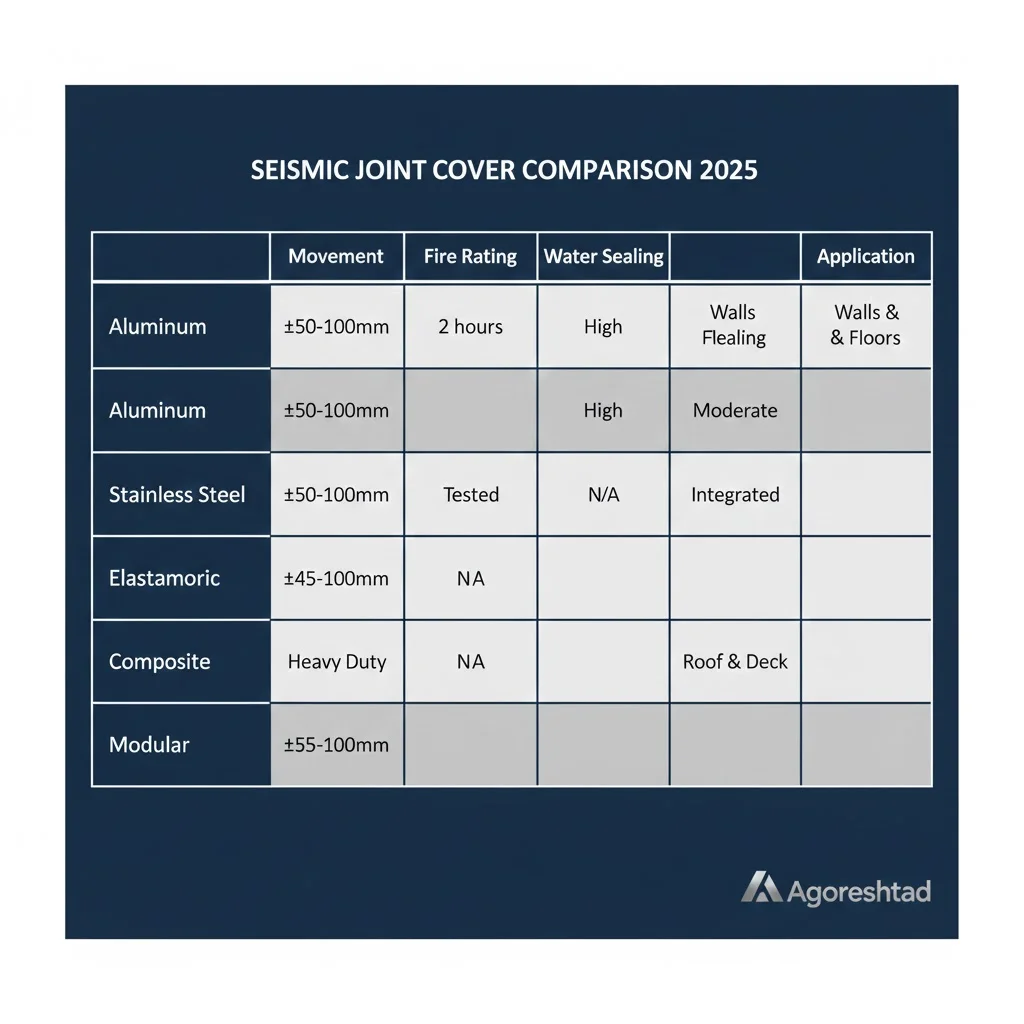
| Cover Type | Allowable Movement | Fire Resistance | Waterproofing | Suitable for | Agor 2025 Model | Anodized Aluminum | ±100 mm | — | ★★★★ | Dry facade | SF-Alu Pro Nano | Stainless Steel 316L | ±150 mm | ★★★★★ | ★★★★★ | Coastal areas | SF-Steel MarineGrade | Nano Elastomeric | ±200 mm | ★★★★ | ★★★★★ | Parking and floors | SF-Elastomeric Pro | Composite + EPDM | ±120 mm | ★★★ | ★★★★ | Economical facade | SF-Hybrid Eco | Modular Click & Lock | ±300 mm | ★★★★★ | ★★★★★ | Super-tall towers | SF-Modular Pro 2025 |
|---|
| Problem | Main Cause | Approximate Repair Cost (20-story tower) | Diagonal facade cracks | Lack of seismic movement absorption | 2.8 billion Tomans | Water leakage from behind the facade | Lack of waterproofing | 1.9 billion Tomans | Stone facade collapse | Direct installation without base rail | 4.5 billion Tomans | Property value reduction | Unsightly appearance and cracks | 15–25% price drop |
|---|
| Period | Suggested Action | Every 6 months | Visual inspection + cleaning | Every 2 years | Waterproofing test (ASTM E331) | Every 5 years | Replace EPDM strips | Every 10 years | Complete structural inspection |
|---|