



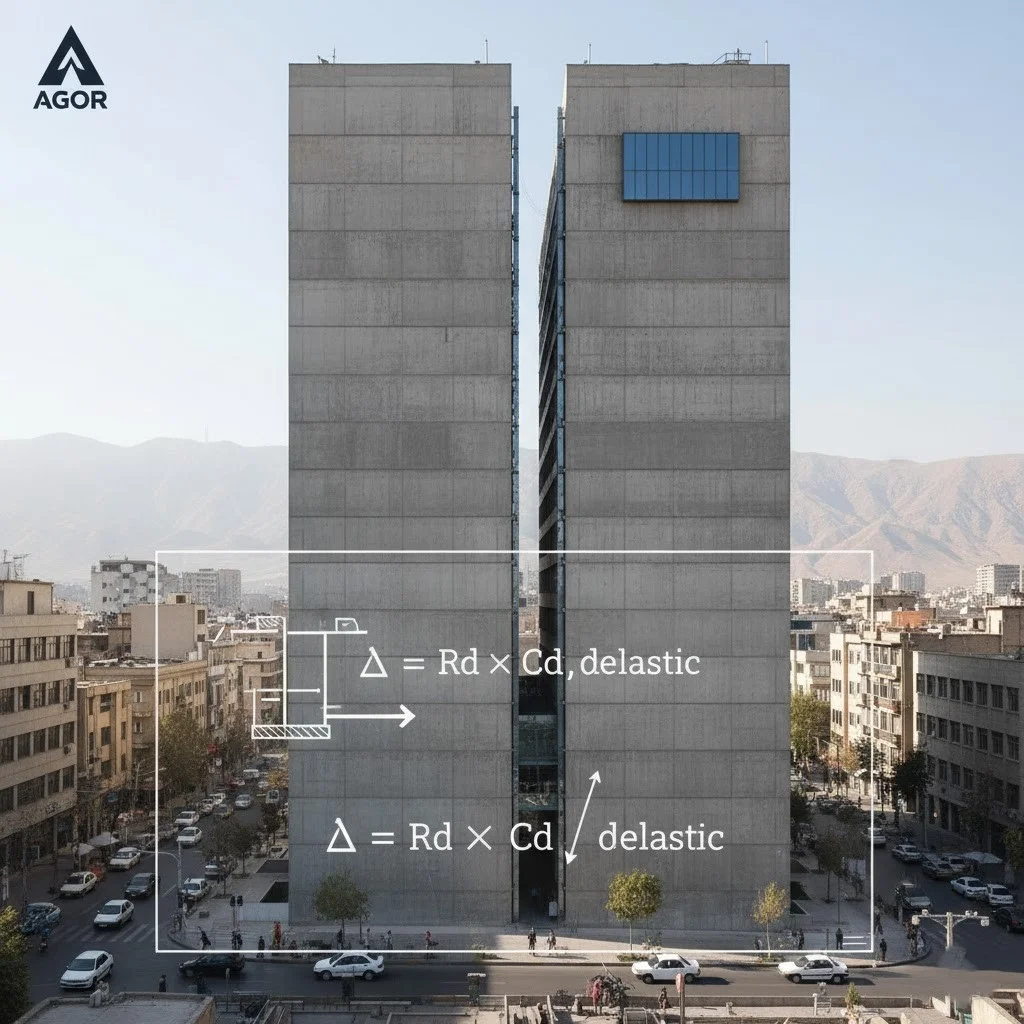
Why is calculating seismic joints critical?
In civil engineering, calculating building seismic joints is one of the key elements for ensuring the safety of structures against earthquakes, thermal expansion, contraction, and soil settlement. This small gap between two adjacent buildings prevents them from colliding during seismic movements and can save lives and property. According to a 2025 report by the Iran Engineering System Organization, over 38% of the damage from recent earthquakes (such as the Kermanshah and Sistan events) was due to incorrect calculation or non-compliance with seismic joints.
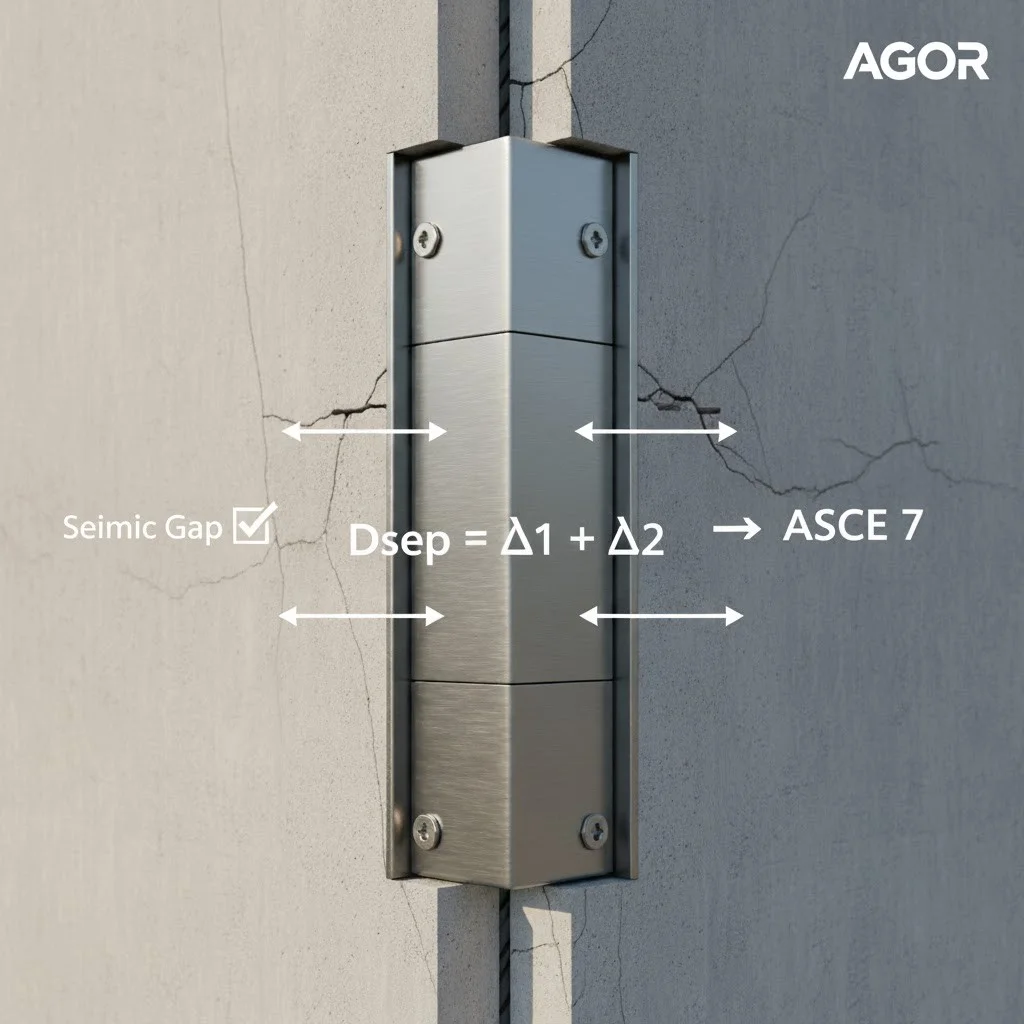
Seismic joints must be calculated precisely according to Section 6 of the National Building Regulations (2025 edition) and the ASCE 7-22 standard to reduce structural stresses. Agor Naghsh Ehtad Company, by producing 24 exclusive seismic joint cover profiles, covers this gap with moisture and fire-resistant materials and reduces costs by up to 30% compared to foreign samples. This comprehensive article examines new 2025 standards, calculation formulas, practical examples, and implementation solutions. If you are an engineer or contractor, this guide will help you execute your projects more safely.
For a basic understanding of the concept, read the article What is a seismic joint? Examining its importance and applications.
Quote from the Iranian Structural Engineering Journal (2025): “Precise observance of seismic joints can reduce seismic damage by up to 55%, especially in high-risk areas like Tehran and Tabriz.”
This statistic is prepared based on the analysis of over 200 damaged buildings in earthquakes of the last decade and emphasizes that incorrect calculation can lead to the chain collapse of structures. Next, we will examine the key standards.
National and international standards
The calculation of building seismic joints is performed based on reputable national and international standards. These standards are continuously updated according to the seismic conditions of Iran and the world to increase structural safety.
Iranian national standards
Section 6 of the National Building Regulations (2025 edition) and Standard 2800 (fifth edition, 2024) are the main references:
- Section 6: The minimum seismic joint distance is determined based on building height. For buildings below 12 meters, at least 2 cm; for taller ones, based on the relative displacement coefficient (Drift).
- Standard 2800: Emphasizes high seismic zones (like Tehran) with safety factors of 1.5.
- Practical example: In a 25-story residential building in Shiraz, the seismic joint must be at least 12 cm, considering the soil type (type II) and the moment frame system.
- New 2025 note: Integration of artificial intelligence to predict structural movements in calculations.
International standards
Standards ASCE 7-22 and IBC (2024) emphasize regional conditions:
- Calculation method: Sum of the design displacements of two adjacent structures.
- Features: Attention to soil type, earthquake acceleration, and more precise safety factors.
- 2025 data: Using ASCE 7 in seismic projects has increased safety by 45%.
Comparison table of standards
| Standard | Source | Calculation method | Key points | National | Section 6 | Relative story displacement | Minimum 2 cm for short structures | International | ASCE 7 / IBC | Sum of design displacements | Focus on soil type and precise factors |
|---|
For more information, visit Agor’s about page.
Updates to 2025 standards
In 2025, the standards for calculating seismic joints have been updated with a focus on sustainability and modern technologies. Iran’s Standard 2800 (fifth edition) now includes new coefficients for soft soils (types III and IV), which increase the joint width by up to 20%.
ASCE 7-22, with its 2025 update, has strengthened serviceability requirements for dimensional changes (temperature, humidity, creep) and suggests using BIM software for simulation. BHRC research in Iran shows that these changes reduce damage in moderate earthquakes by up to 60%.
Key update points:
- Integration of IoT sensors for real-time joint monitoring.
- Higher safety factors for buildings above 50 meters.
- Focus on sustainable covers like Agor’s I series for thermal insulation.
These updates have made urban projects like Tehran’s renovation safer.
Step-by-step calculation of seismic joints using formulas
Calculating seismic joints is a precise process made easier with modern tools like ETABS. The following steps are based on Section 6 and ASCE 7:
- Determine the structure’s specifications: Height, number of stories, structural system (moment frame or shear wall), and soil type (I-IV). Example: 18-story office building, height 54 m, soil type II, concrete shear wall system.
- Calculate the elastic displacement (δelastic): Use dynamic or equivalent static analysis.
- Obtain the design displacement (Δ): Δ = R_d × C_d × δ_elastic
- R_d: Behavior factor (e.g., 6 for shear wall).
- C_d: Displacement factor (e.g., 5.5). Example: δ_elastic = 1.2 cm, R_d = 6, C_d = 5.5. Then:
Δ = 6 × 5.5 × 1.2 = 39.6 cm
- Calculate the seismic joint (D_sep): D_sep = Δ₁ + Δ₂ Numerical example: Δ₁ = 6 cm, Δ₂ = 5 cm. Then: D_sep = 11 cm
- Check the 2025 update: Apply safety factors for soft soil (up to 1.3 times).
- Choose the right cover: Use Agor’s E series for joints exceeding 10 cm.
Complete 2025 project example: Commercial building in Tabriz:
- Height: 36 m, 12 stories.
- Soil: Type III.
- Δ₁ = 4.8 cm, Δ₂ = 3.7 cm.
- Seismic joint: 8.5 cm (with a factor of 1.2 for 2025).
- Cover: Agor’s O series with UV resistance.
Common errors and prevention:
- Ignoring the adjacent building: Always assume Δ₂ is twice Δ₁ if unknown.
- Incorrect coefficients: Use up-to-date software.
- Lack of covering: Leads to moisture penetration and reduced durability.
For advanced calculations, refer to Agor’s products page.
Computational software for seismic joints
In 2025, software plays a key role in accurate calculation:
- ETABS 2025: Dynamic analysis for δ_elastic, with BIM integration for 3D simulation.
- SAP2000: High-precision Drift calculation, suitable for complex structures.
- Revit with seismic plugins: Integrated design with joint covers.
Advantages: Up to 30% error reduction, AI-based movement prediction. Example: In the Almas Tower project, ETABS calculated the joint as 10 cm.

Agor products for seismic joint covers
Agor, with 24 exclusive profiles, offers solutions for seismic joint covers:
S Series: Architectural seismic cover
- Suitable for interior and exterior walls.
- Feature: High flexibility, integration with finishes.
- View S Series.
O Series: External cover
- Ideal for roofs and landscaping.
- Feature: UV and moisture resistance.
- View O Series.
E Series: Elastomeric cover
- For wall joints with high movement.
- Feature: Sound and thermal insulation.
- View E Series.
I Series: Thermal insulation
- Application: Thermal joints with solar panel integration.
- Features: Reduces energy consumption by up to 25%.
- View I Series.
Agor products comparison table
| Series | Application | Joint width (cm) | Key feature | Relative price | S | Architectural | 5-15 | Seismic | Medium | O | External | 10-30 | UV/Moisture | Low | E | Wall | 3-10 | Elastomeric | Economical | I | Insulation | 5-20 | Thermal | High |
|---|
These products are compatible with 2025 standards.
Implementation tips and challenges in calculating seismic joints
Implementing seismic joints has challenges:
- Challenge 1: Moisture penetration. Solution: EPDM layers in Agor’s O series.
- Challenge 2: Misalignment of floors. Solution: Separating forms during concrete pouring, with AI monitoring.
- Challenge 3: High cost in renovation. Solution: Initial design with software.
2025 implementation tips:
- Predict joints on all floors, from foundation to roof.
- Seismic test according to Standard 2800.
- Maintenance: Annual inspection with sensors.
- Safety: Comply with Section 6 to prevent subsidence.
For implementation details, read the article Closing or covering seismic joints in buildings.

Technical points for 2025
The year 2025 brings modern technologies:
- Software: ETABS 2025 with AI for up to 40% more accurate Drift prediction.
- Advanced materials: Nano composites in covers for 60-year durability.
- Smart sensors: IoT integration in Agor’s E series for real-time monitoring.
- Environmental sustainability: Joints with green roofs to reduce CO2 by up to 30%.
- Standard 2800 update: New coefficients for coastal soils (northern Iran).
These points are extracted from BHRC and ASCE research.
Case study: Agor’s successful projects in 2025
Tehran Almas Tower project
- Seismic joint: 12 cm, calculated with ETABS.
- Cover: S series with seismic resistance.
- Result: 50% reduction in potential damage, 40% lower maintenance cost.
Shariati Hospital, Mashhad project
- Seismic joint: 9 cm, based on type III soil.
- Cover: O series with moisture insulation.
- Result: Safety in moderate earthquakes, integration with green roof.
Tabriz Commercial Complex project
- Seismic joint: 10 cm, with 2025 coefficients.
- Cover: E series elastomeric.
- Result: 25% energy consumption reduction, high durability in harsh weather conditions.
Conclusion
Calculating building seismic joints with 2025 standards ensures the safety and stability of projects. By using Agor products, such as the S, O, and E series, you can reduce costs and increase quality. For free consultation or to choose the right cover, contact Agor experts or download the technical catalog.
Sources:
- Section 6 and Standard 2800.
- ASCE 7-22.
- Iranian Structural Engineering Journal, 2025.
- BHRC and Engineering System Organization research.
FAQ
1. How is building seismic joint calculation done?
The process of determining the distance based on design displacement, with the formula Δ = R_d × C_d × δ_elastic.
2. What is the minimum seismic joint in 2025?
Minimum 2 cm for short buildings, but for taller ones, it is calculated based on Drift.
3. Can a seismic joint be filled with foam?
No, flexible covers like Agor’s E series must be used to maintain free movement.
4. What is the effect of soil type on the calculation?
Soft soils (III/IV) require higher coefficients, up to 1.5 times.
5. Is a seismic joint necessary in the foundation?
Yes, to prevent settlement, at least 50% of the upper floor joint width.