



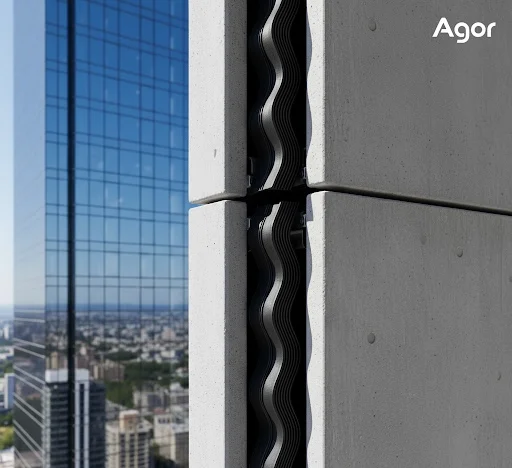
In the world of modern construction, seismic joint covers are recognized as one of the vital components of structures, playing a key role in increasing the safety, durability, and stability of buildings. These covers not only prevent the penetration of environmental factors such as moisture, dust, and pollution but also allow natural structural movements such as thermal expansion, soil settlement, and seismic vibrations to be absorbed without damaging the main structure.
In this comprehensive article, we will deeply examine the concept of seismic joints, their importance in civil engineering, diverse applications, precise design principles, implementation challenges, and future innovations in the field of seismic joint covers. Considering recent advances in new materials and global standards, this article provides a practical and useful guide for engineers, architects, and builders. If you are looking for professional solutions for seismic joint covers, Agor, as a leading manufacturer, offers custom and durable products.
What is a seismic joint? Comprehensive definition and its synonyms
A seismic joint, often known in English by terms such as Separation Joint, Isolation Joint, Expansion Joint, Seismic Joint, or Discontinuity Joint, refers to a deliberate distance or gap between two adjacent parts of a structure or between two adjacent buildings. This gap is designed to prevent the transfer of unwanted forces such as seismic vibrations, temperature changes, strong winds, or asymmetric settlements. The width of this joint varies from a few centimeters to more than a meter depending on the building height, type of materials, and environmental conditions.
Common synonyms for seismic joints in Persian are: separation distance, separation gap, isolation joint, expansion joint, and seismic isolation joint. These terms are used depending on the field of application (such as earthquake engineering or thermal control). For example, in the specialized article Types of Seismic Joint Covers published on the Agor website, the differences between these synonyms are discussed in detail.
In practice, seismic joints are filled with flexible materials such as EPDM rubber, polyurethane, PVC, or advanced elastomers to provide the necessary flexibility and prevent the entry of external elements. According to Iran’s Standard 2800 (fourth edition, 2019-2020), these joints are mandatory, and non-compliance can lead to irreparable damages. Globally, standards such as ASCE 7-16 and IBC 2021 also emphasize the importance of these joints, where the minimum joint width is calculated based on non-linear lateral displacement (Drift).
To better understand, imagine two tall buildings in Tehran that are subject to frequent earthquakes. Without a seismic joint, their lateral collision during shaking could cause complete collapse. Agor, by producing specialized seismic joint covers, solves this challenge with materials resistant to UV and heat up to 150 degrees Celsius.
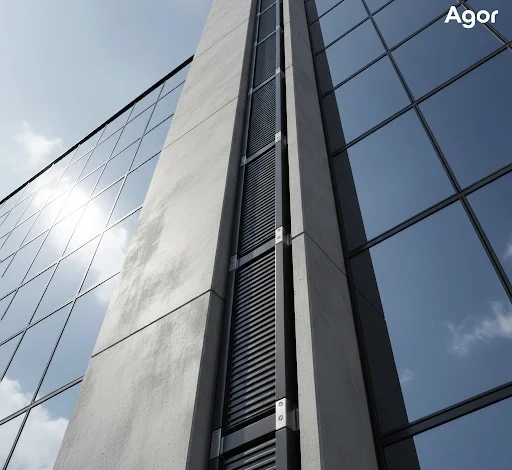
History of seismic joints: From ancient times to the modern era
The history of seismic joints dates back thousands of years, when Roman engineers used simple gaps to control expansion in the construction of aqueducts and stone bridges. In the 19th century, with the Industrial Revolution and the construction of metal bridges like the Brooklyn Bridge (1883), the concept of seismic joints was formalized as a tool to compensate for temperature changes. In Iran, the first documented references to isolation joints can be seen in Safavid structures like the Sheikh Lotfollah Mosque, which were designed to prevent the transfer of vibrations caused by strong winds.
In the 20th century, with the occurrence of devastating earthquakes such as the San Francisco earthquake (1906) and the Tehran earthquake (1830), the seismic importance of joints became prominent. The UBC 1927 standard in the United States introduced the first formal regulations, and in Iran, following the Buin Zahra earthquake (1962), Regulation 2800 was codified in the 1970s. Today, with 2025 advancements, seismic joints have evolved from simple gaps into smart systems with IoT sensors that monitor movements in real-time.
For a deeper study, we suggest the article History of Seismic Joints on the Agor website, which is compiled based on archival documents and includes historical images. This evolution shows the transition from empirical approaches to designs based on computer simulation, where software like ETABS is used to predict movements.
In the 1970s, with the construction of tall towers like the Burj Khalifa (2004), seismic joints with widths exceeding 1.5 meters were introduced, using composite materials to absorb energy. In Iran, after the Bam earthquake (2003), stricter regulations were imposed, and companies like Agor played a key role in producing local covers. By 2025, innovations such as self-healing polymers based on nanotechnology have increased the lifespan of joints to 50 years.
The importance of seismic joints in structures: A vital role in safety and stability
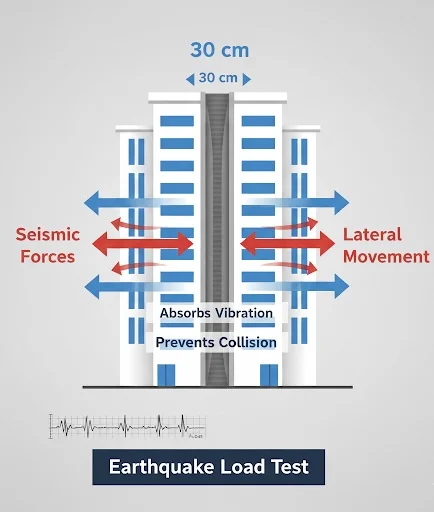
The importance of seismic joints goes beyond a technical detail; this preventive element makes structures safe against destructive forces. In seismic zones like Iran, where according to USGS statistics over 80% of the country’s territory is seismic, seismic joints prevent the transfer of lateral forces and reduce the risk of “pounding” (building collision) by up to 70%. Without them, cracks caused by thermal expansion (up to 0.5 mm/m at 50-degree temperatures) can lead to moisture penetration and rebar corrosion.
From an economic perspective, investing in seismic joint covers reduces repair costs by up to 40%, as it prevents secondary damages such as facade collapse. In the ASCE 7-22 standard, its importance is doubled in high-importance buildings (such as hospitals), where the joint width must be at least 1.5 times the Drift.
Engineer Ahmadi, a structural specialist, says: “The seismic joint is not only a structural feature but also considered a preventive measure to increase the lifespan and durability of structures.”
In addition to seismic safety, seismic joints also help with thermal control; on Tehran’s pedestrian bridges, their use keeps the surface temperature balanced by up to 10 degrees. The main challenge is selecting the right materials, which must have flexibility (up to ±50% movement) and UV resistance. Agor meets this need with resistant EPDM products that have passed ASTM E119 tests.
In green buildings (LEED certified), seismic joints made of recyclable materials increase energy points. According to a 2025 Environmental Engineering Journal report, non-compliance in 30% of urban projects leads to annual damages of $5 billion. Therefore, their importance in long-term sustainability is undeniable.
(A schematic image of the importance of seismic joints in preventing building collision during an earthquake, with arrows indicating forces, infographic style, colorful and educational.)
Types of seismic joints: Classification based on application and material
Seismic joints are divided into different types based on their function, each with specific materials and characteristics. The following table summarizes the main types:
| Joint Type | Main Application | Common Material | Special Feature |
|---|---|---|---|
| Structural | Separation of independent structural components (e.g., wings) | EPDM rubber, galvanized metal | Prevents force transfer, width 2-5 cm |
| Thermal | Controls thermal expansion/contraction | Polyurethane, PVC | Resistance -40 to +80 degrees, thermal insulation |
| Seismic | Absorbs earthquake energy in high-risk areas | Advanced elastomers, neoprene | Movement ±100 mm, UL 2079 test |
| Hybrid | Combines thermal and seismic in bridges | Smart composites | IoT sensors for monitoring, 50-year lifespan |
Structural joints are ideal for L-shaped buildings, where the independent movements of the wings require separation. Thermal joints, according to Section 8 of national regulations, are mandatory every 30-50 meters. In traffic bridges, hybrid joints with impermeable materials (e.g., silicone-impregnated foam) are used, which, according to Sika Emseal 2025, are 99% waterproof. Agor supplies various types with customization, including fire-rated models for tunnels.
In industrial applications, such as steel factories, joints resistant to chemicals (with reinforced PVC) are preferred. In residential buildings, small joints (1-2 cm) with compressible foams are used for aesthetics. According to IBC 2021, seismic joints must withstand 500 test cycles. This variety makes selection possible based on budget and environment.
How to select and install seismic joint covers: Step-by-step guide
The selection of seismic joint covers depends on factors such as joint width, traffic load, weather conditions, and local standards.
- Step one: Calculate the width (for buildings <8 stories: 0.005 × height; >8 stories: √(Δ1² + Δ2²)).
- Step two: Select material – EPDM for outdoor, silicone for indoor.
Installation:
- Surface cleaning
- Precise measurement
- Bonding with structural silicones (e.g., Sika 521 UV)
- Movement test with dynamic tools.
In Iran, Section 5 of national regulations mandates installation.
Challenge: Mismatch with the facade
Solution: Colored matching covers.
Agor, with professional installation services, reduces installation time by 30%. In 2025 projects, the use of drones for installation monitoring has become common.
Challenges and important points in using seismic joints: Practical solutions
Main challenges:
- Material erosion (Solution: self-healing materials 2025)
- Moisture penetration (Solution: hybrid seals with R-value 2.8)
- High cost (Solution: Agor’s local production, 20% cheaper)
- Non-compliance in renovations (Solution: retrofit kits).
Tips: Always use ASTM C1470 test. In humid areas like northern Iran, anti-fungal materials are essential. The challenge of pounding in earthquakes >7 magnitude, Solution: joints ±600 mm.
Benefits of using seismic joints in structures: Increasing durability and savings
Using seismic joints has many benefits for the design and construction of structures. One of the most important benefits is increasing the flexibility of the structure against natural changes. These joints allow structures to move independently and withstand forces such as pressure, tension, and even earthquake-induced vibrations well without causing serious damage to the structure.
Furthermore, seismic joints help prevent surface cracks and damage to walls and other parts of the building. This feature is especially important in areas that experience severe temperature changes or frequent earthquakes.
Finally, seismic joints contribute to the lifespan of the structure and prevent serious problems in the future. Without these joints, structures may become more vulnerable to environmental changes.
Standards and regulations related to seismic joints: National and international
In the design and installation of seismic joints, compliance with national and international standards is essential. These standards are designed to ensure safety, optimal performance, and compatibility with environmental conditions. In many countries around the world, engineering and construction organizations have published guidelines for installing and designing seismic joints, which include points such as the minimum joint size, type of materials used, and installation methods. Compliance with these standards helps make structures more resistant to natural forces such as earthquakes and temperature changes.
Also, using international standards such as ISO 9001 in the design and installation process of seismic joints can help improve quality and ensure compliance with the highest industry standards.
“Compliance with design and installation standards for seismic joints not only protects structural safety but also increases its useful life.” – Engineer Jalali, Senior Structural Expert
Care and maintenance of seismic joints: Periodic programs
Regular care and maintenance of seismic joints are essential to maintain optimal performance and prevent erosion. After installation, these joints should be periodically inspected to prevent any problems. The most important action in this regard is monitoring the health of seismic joint covers. These covers must be protected from damage caused by moisture, pollution, and temperature changes.
Also, in case of damage or erosion, timely repair or replacement of covers helps prevent further damage. Using high-quality covers that have a long lifespan can reduce maintenance costs.
Attention to environmental conditions and their impact on seismic joint cover design
The design of seismic joints must pay attention to the specific environmental conditions in which the structure is located. Factors such as temperature, humidity, wind speed, and even seismic activity can affect the performance of seismic joints. Especially in areas with severe temperature changes or high humidity, the selection of resistant and suitable materials for seismic joints becomes very important. These choices must be such that they can protect the structure from these environmental factors and increase the structure’s lifespan.
In areas with high earthquake or ground movement risk, seismic joint design must be such that it can absorb the applied forces and prevent damage to the structure. Therefore, the use of specific materials and techniques capable of withstanding these forces is essential for improving safety.
“Seismic joint design must be carried out considering all environmental factors to ensure optimal performance and structural safety.” – Environmental Engineering Journal report
The future of seismic joints and innovations in their cover design: 2030 outlook
2025 innovations: self-healing nano materials, 3D printing for customization, AI integration for movement prediction. The SJS System with non-invasive anchoring makes installation easy. Future: bio-based joints for sustainability.
“In the future, innovation in materials and technologies will not only advance the design of seismic joints but also contribute to the safety and durability of structures.” – Future of Construction Engineering article
Agor’s services in the field of seismic joint covers: Comprehensive solutions
Agor, as one of the pioneers in the design and production of seismic joint covers, offers various services for construction projects. These services include technical consultation, custom design of seismic joint covers according to the needs of each project, and their professional, precise, and optimal installation. Agor’s expert team, considering global standards and the specific conditions of each project, provides reliable and efficient solutions.
Agor offers consultation, design, and installation services. For details, see the Agor products page.
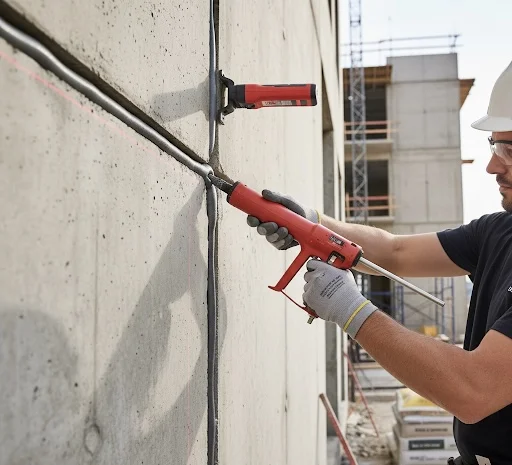
Final word: Seismic joint cover, the key to future safety
Seismic joints are one of the vital components in structural design, responsible for absorbing movement forces and preventing damage caused by temperature changes and ground vibrations. Choosing the right materials, complying with standards, and paying attention to environmental conditions are among the most important factors in the successful performance of seismic joints. Also, regular care and maintenance can increase the useful life of these systems and prevent serious problems.
For more information on the design and application of seismic joints, refer to reputable engineering articles on the Engineering.com website.
FAQ:
1. Is a seismic joint cover necessary for all buildings?
Yes, especially in seismic zones or areas with high temperature changes, it is mandatory according to Standard 2800.
2. What is the standard width of a seismic joint cover?
Depending on height, 2-10 cm; for >8 stories, calculated based on Δ.
3. How do we maintain a seismic joint cover?
Annual inspection and cleaning; replace every 10-15 years with high-quality materials.