
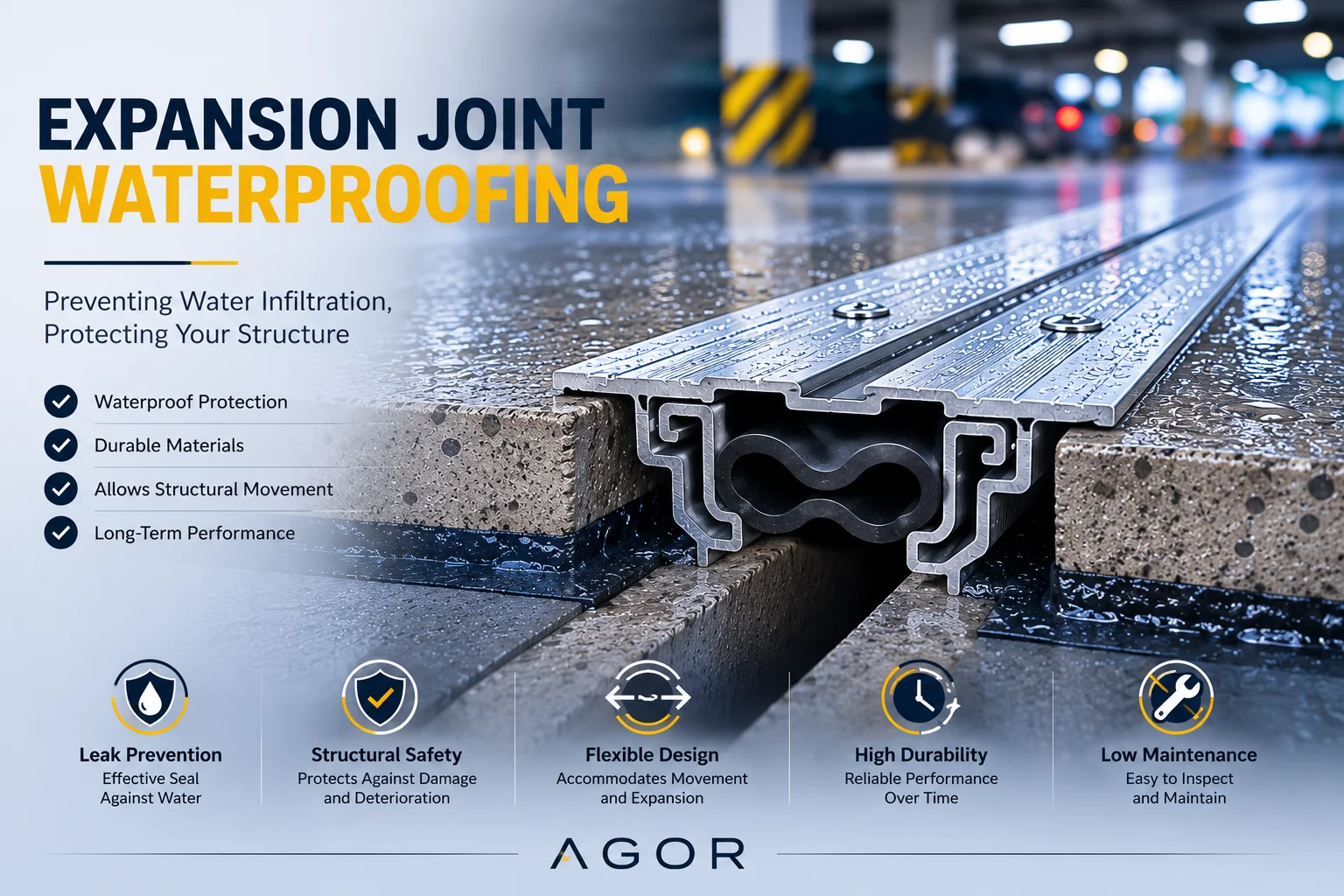
Expansion joints are designed to control structural movement, reduce stresses caused by earthquakes, thermal changes, and possible settlement in buildings. However, if this structural gap is left without a standard cover and waterproofing system, it can become one of the main paths for water, moisture, dust, and dirt infiltration. For this reason, expansion joint waterproofing is one of the most important stages in the proper execution of construction projects.
In many buildings, the problem becomes visible when water penetrates through the joints into lower floors, parking areas, walls, or service spaces. This can lead to material deterioration, stains, corrosion, unpleasant odors, and even damage to equipment. To learn more about AGOR’s general solutions, you can visit the expansion joint cover page.
Why Is Expansion Joint Waterproofing Important?
Unlike a simple crack, an expansion joint is part of the structural design and must allow controlled movement. Therefore, it cannot be filled with mortar, cement, or any rigid material. If the joint is closed improperly, it may crack, separate, or fail when structural movement or temperature changes occur.
Expansion joint waterproofing must be done in a way that prevents water from entering while still allowing the required movement of the structure. This is especially important in parking garages, roofs, rooftop gardens, facades, basements, and service areas.
Sensitive Areas for Water Infiltration
Water infiltration usually occurs in areas where the joint is directly exposed to rain, floor washing, ground moisture, or severe temperature changes. In real construction projects, the most common problems appear in parking floors, ramps, roofs, external walls, entrance areas, and the connection points between the joint and floor or facade finishes.
In these areas, choosing the right cover should always be combined with a proper waterproofing detail. For example, in the article parking garage expansion joint cover, we explained that parking areas require more durable materials and precise installation because of washing, vehicle pressure, and continuous moisture exposure.
Table: Common Waterproofing Methods Based on Installation Area
| Installation Area | Main Challenge | Recommended Solution | Installation Tip |
|---|---|---|---|
| Parking garages and ramps | Washing, vehicle load, and water penetration | Durable mechanical cover with waterproofing details | Install flush with the floor, secure all fixings, and allow maintenance access |
| Roofs and rooftop gardens | Rain, sunlight, and temperature changes | Mechanical cover combined with flexible waterproofing membrane | Connect the system properly to the roof waterproofing layer |
| Building facades | Rain, wind, and thermal expansion | Facade cover with suitable sealant and UV-resistant material | Seal the edges carefully and consider joint movement |
| Basements and service areas | Constant moisture and possible water pressure | Robust waterproofing system with inspection capability | Check drainage paths and inspect regularly |
| Interior areas with light traffic | Dust and limited cleaning | Lightweight cover with proper sealing | Focus on appearance and compatibility with the final flooring |
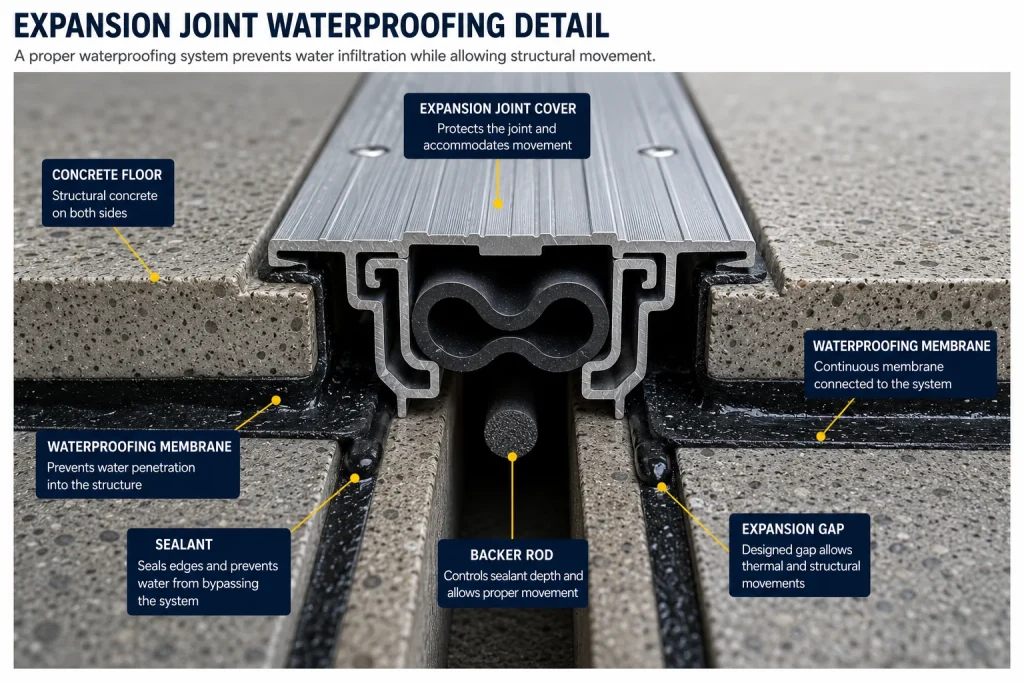
Choosing the Right Waterproofing Material
Material selection does not depend only on joint width. Structural movement, joint location, moisture level, flooring type, weather conditions, and traffic volume should also be considered. A material that works well in an interior space may not perform properly on a roof or in an outdoor parking area.
In projects exposed to continuous moisture, the selected material must resist corrosion, deformation, separation, and premature wear. If the joint is located in a vehicle or pedestrian path, the final surface should also be safe, flush, and free from dangerous edges. To compare systems more clearly, reading the article on types of expansion joint covers can be useful.
The Role of Substrate Preparation in Waterproofing Performance
Even if the best product is selected, weak substrate preparation can reduce or completely eliminate its performance. Both sides of the joint must be clean, dry, level, and strong. Dust, trapped moisture, cracks, weak materials, or improper slope can prevent the cover and waterproofing layer from bonding or functioning correctly.
In professional installation, the joint width, edge condition, floor slope, fixing points, and possible water movement path are checked before final installation. For a more detailed explanation of this stage, you can read the article on substrate preparation and installation of expansion joint cover profiles.
Common Mistakes in Joint Waterproofing
One of the most common mistakes is filling the entire joint with rigid materials such as mortar or cement. This may seem to solve the problem at first, but it blocks the natural movement of the structure and eventually causes cracking or material failure.
Another mistake is using unsuitable adhesives or sealants in wet or high-traffic environments. Some materials do not have enough resistance against sunlight, water, cleaning chemicals, or mechanical pressure. As a result, expansion joint waterproofing may fail after a short time and lead to leakage.
Ignoring slope and drainage is also a major installation mistake. If water collects around the joint, even a good system will be under constant pressure over time. Therefore, water drainage design is especially important on roofs, parking areas, and outdoor spaces.
Periodic Maintenance and Inspection
Waterproofing is not a one-time task. In buildings where joints are exposed to traffic, moisture, or temperature changes, periodic inspection is very important. The condition of edges, screws, sealants, possible deformation, and moisture marks around the joint should be checked regularly.
If leakage, moisture odor, stains on the ceiling below, loose profiles, or open edges are observed, the issue should be inspected as soon as possible. Delaying repairs can significantly increase future maintenance costs.
Conclusion
Expansion joint waterproofing is not only about preventing water from entering the building. It is also part of the durability, safety, and execution quality of the structure. It should be designed and installed according to the installation area, joint width, structural movement, moisture conditions, and suitable materials.
In sensitive projects such as parking garages, roofs, rooftop gardens, facades, and basements, selecting a standard product and applying precise installation details is even more important. Expansion joint waterproofing delivers long-term performance when the cover, substrate preparation, sealing, and periodic maintenance are considered as one complete system.