



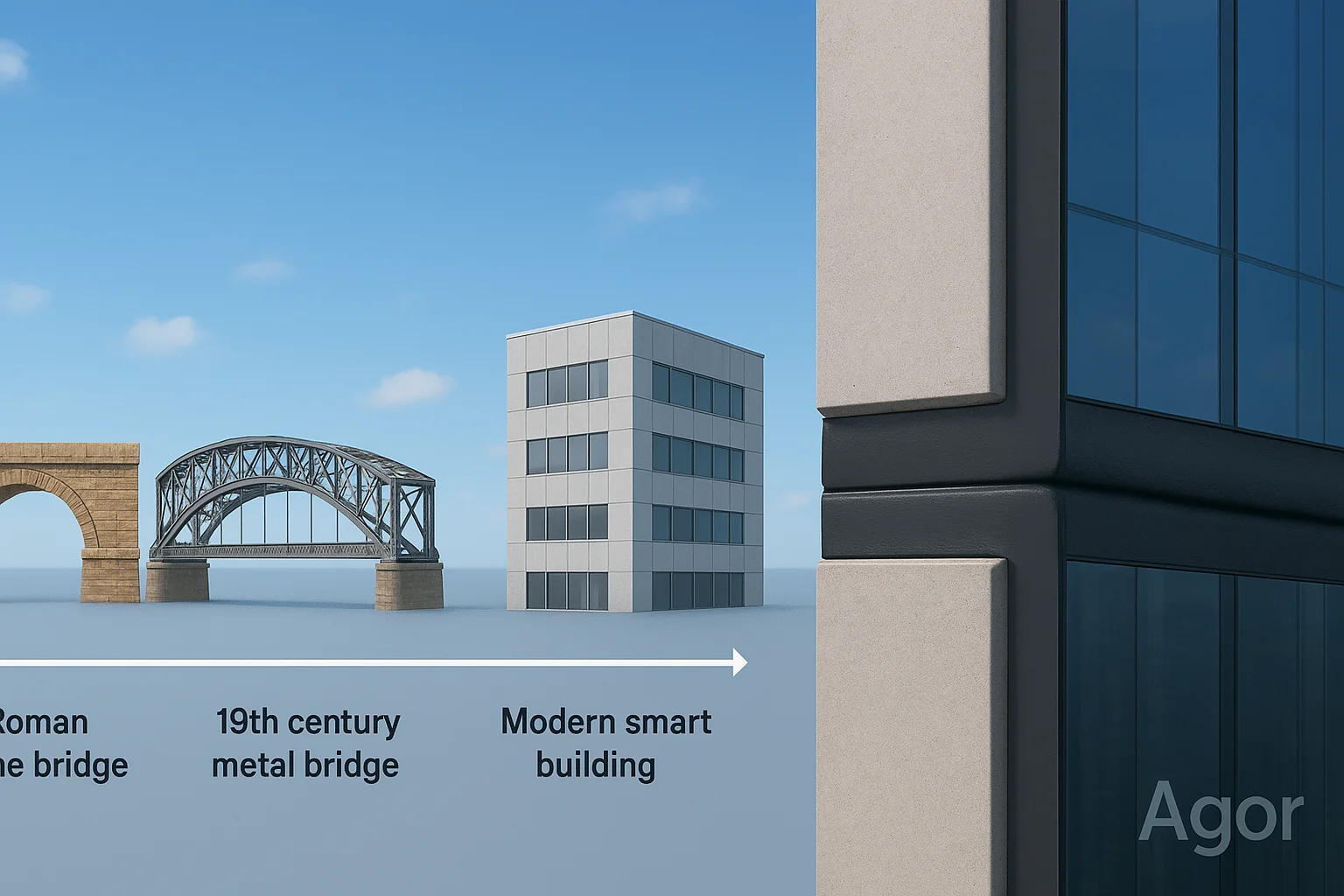
In the world of modern architecture and civil engineering, seismic joint covers act as one of the key elements in increasing the safety and durability of structures. These covers not only absorb movements caused by thermal expansion, soil settlement, and seismic vibrations but also prevent the penetration of moisture, dust, and environmental factors, preserving the aesthetic appearance of the building. Considering the rich history of seismic joints, which has evolved from ancient times to advanced 2025 standards, this article comprehensively examines the evolutionary journey, relevant regulations, and their impact on building safety.
The information is updated based on reliable sources such as ASCE and Iran’s national regulations, with a focus on future innovations. For a more complete understanding of the concept of seismic joints, read the article “What is a seismic joint?”.
What is a seismic joint? An introduction to its concept and importance
A seismic joint, known in English as an Expansion Joint or Seismic Joint, is a deliberate gap in structures designed to compensate for movements caused by temperature changes, seismic vibrations, strong winds, or soil settlement. Without these joints, expansion stresses can lead to cracking, structural damage, and even collapse. The importance of seismic joint covers in maintaining building integrity is critical, as flexible materials such as EPDM or elastomers not only facilitate movement but also prevent the entry of destructive elements.
In ASCE 7-22 standards, the seismic joint is part of serviceability requirements that control dimensional changes due to temperature, humidity, and creep. In Iran, Section 6 of the National Building Regulations (2019-2020 edition) emphasizes compliance with the minimum joint width (based on building height) to ensure safety in seismic zones. For related products, check out Agor’s seismic covers, which are compatible with ASTM E119 standards.
History of seismic joints in the world: From ancient times to the Industrial Revolution
The history of seismic joints dates back to ancient Rome, where Roman engineers used simple gaps in the construction of bridges and aqueducts to compensate for the thermal expansion of stones. This primitive technique was designed to prevent cracking due to seasonal temperature changes. In the Middle Ages, with the construction of churches and castles, isolation joints were used to reduce the effects of ground vibrations and strong winds, albeit without precise scientific calculations.
The Industrial Revolution in the 19th century was a turning point; with the construction of metal bridges like the Brooklyn Bridge (1883), the concept of seismic joints was formalized as a tool to compensate for metal expansion. The formula ∆ = α L ∆T (where α is the thermal expansion coefficient, L is length, and ∆T is temperature change) was introduced to determine joint width. In the early 20th century, the San Francisco earthquake (1906) highlighted its seismic importance, where the lack of building separation led to widespread damage. In the 1920s, the UBC (Uniform Building Code) in the United States proposed a minimum lateral force of 0.075W for joints.
History of seismic joints in Iran: From traditional architecture to modern regulations
In Iran, the roots of seismic joints date back to the Safavid era, where architects in structures like the Sheikh Lotfollah Mosque used flexible gaps to cope with frequent earthquakes. This empirical method made structures resistant to ground vibrations. During the Qajar era, with the construction of caravanserais and bridges, separation of sections for thermal expansion became common.
After the Industrial Revolution and the Buin Zahra earthquake (1962), Regulation 2800 was codified in the 1970s, making seismic joints mandatory. The Bam earthquake (2003) led to stricter revisions of Section 6 of the national regulations, which calculates joint width based on Drift (lateral displacement). By 2025, with a focus on reinforcement, seismic joints are mandatory in over 80% of urban projects. Agor meets this need with resistant local covers.
Comparative table: Historical developments of seismic joints in the world and Iran
| Historical Period | World | Iran |
|---|---|---|
| Ancient Rome | Separation of stones in bridges to cope with temperature changes | Use of gaps in traditional architecture for greater flexibility |
| Middle Ages | Beginning of scientific understanding of structural isolation | Traditional use in earthquake-resistant buildings |
| Industrial Revolution | Entry into scientific and computational design | Spread of awareness after multiple 20th-century earthquakes |
| 21st Century | Digital design, use of smart materials | Codification of national building regulations, widespread use in projects |
When seismic joints became mandatory in regulations: The impact of key earthquakes
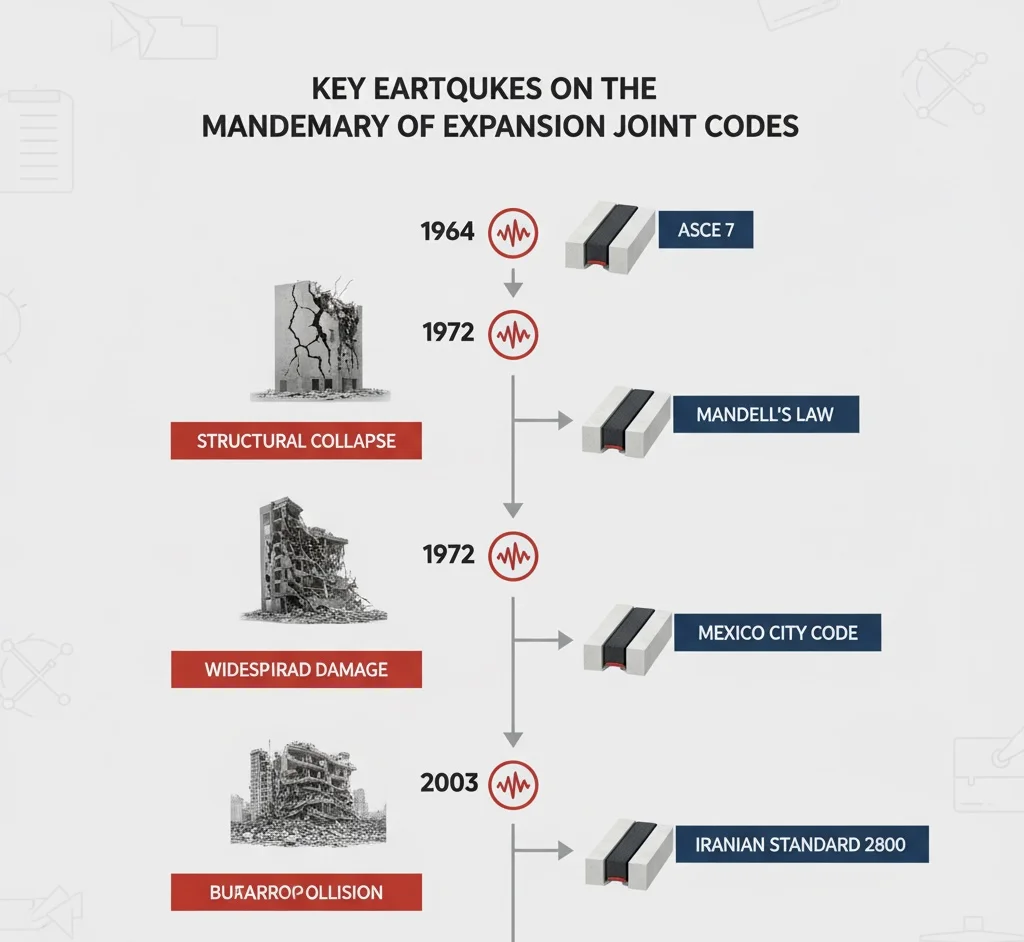
The mandatory requirement for seismic joints occurred after devastating earthquakes. The Alaska earthquake (1964, magnitude 9.2) showed that a 10 cm gap was insufficient and building collisions caused heavy damage. The Managua earthquake (1972) and Mexico City earthquake (1985) led to the adoption of ASCE 7 standards, which made joints mandatory to prevent pounding.
In Iran, after the earthquakes of the 1980s-1990s, Section 6 (2019-2020 edition) set a minimum width of 0.01h (h is height). Standard 2800, fourth edition (2019-2020), focuses on seismic joints. For an in-depth study, we suggest the article on seismic joint regulations in Iran.
The evolution of seismic joint design: From simple to smart
Seismic joint design has evolved from simple gaps in the 19th century to modular systems in 2025. Globally, polymer materials such as PVC and elastomers have replaced metals, and BIM software is used for movement simulation.
In Iran, after recent earthquakes, design is based on ∆ = √(Δ1² + Δ2²) for multi-directional movements. Innovations include fire-rated covers with UL 2079 testing. Agor offers custom solutions on its design services page.
The future of seismic joints and innovations in their covers up to 2030
By 2025, innovations include nano self-healing materials, IoT sensors for real-time monitoring, and recyclable green materials. Modular covers with carbon fiber composites increase lifespan to 50 years. In the future, 3D printing and AI will enable movement prediction, reducing maintenance costs by 30%.
In Iran, with a focus on sustainability, bio-based materials are being developed for seismic zones. Agor is leading with 2025 innovations.
| Future Innovation | Benefits |
|---|---|
| Self-healing covers | Automatic crack repair and increased structural lifespan |
| Use of nanocomposite materials | High resistance to environmental factors and structural movements |
| Green technologies | Reduced energy consumption and use of recycled materials |
| Smart design software | More precise design and prediction of structural behavior in real conditions |

The importance of seismic joints in modern architecture: Applications and impact on building safety and aesthetics
In the world of modern architecture, seismic joints have become one of the vital components that greatly impact building safety and aesthetics. Seismic joints not only serve as a way to prevent structural and thermal movements but also as a tool to increase the durability and stability of buildings. Below are some applications of seismic joints in modern architecture:
- Applications and impact on safety: Seismic joints are specifically designed to prevent cracks and structural damage due to temperature changes, humidity, and vibrations from seismic activity. These joints help buildings effectively respond to movements caused by the contraction and expansion of materials and prevent structural problems. Additionally, using appropriate seismic joint covers can help prevent water and dust from penetrating into buildings, which improves interior conditions and reduces maintenance costs.
- Impact on aesthetics: In addition to technical applications, seismic joints play an important role in the aesthetics of buildings. Modern and attractive designs of seismic joint covers can create a special effect harmonious with the overall architecture of the building. Using appropriate seismic joint covers not only technically protects the building but also adds beauty to the exterior facade and interior design.
Agor’s role in the seismic joint industry: Agor’s specific products and services
Agor, as one of the pioneers in the design and production of seismic joint covers, has always strived to provide high-quality products and special services to improve structural performance for the safety and beauty of buildings.
- Agor products: Agor offers a range of seismic joint covers with unique features designed according to the various needs of construction projects. These products include covers resistant to temperature changes, humidity, and physical pressures, and in addition, have high aesthetic capability that helps greater harmony with building architecture. If you wish, please visit Agor products.
- Agor’s specialized services: Agor not only supplies high-quality products to the market but also offers consulting services and specialized installation of seismic joint covers. Agor’s expert team, considering the needs of different projects, suggests the best solutions for implementing seismic joints and their covers and supervises their execution at the highest level of standards.
Given these points, seismic joints are constantly evolving, and companies like Agor, with their innovations in this field, play an important role in improving the quality and durability of structures.
Final word:
Looking to the future, we will continue to see more innovations in the design and use of seismic joints. New technologies, smart materials, and attention to sustainability are parts of the trends that can shape the future of this industry. Ultimately, the goal of optimal use of seismic joints is not only to maintain building health but also to improve the overall performance of structures and reduce repair and maintenance costs. The history of seismic joints shows progress towards greater safety. With Agor’s innovations, we have a safer future.
FAQ:
1. In which period was the seismic joint first used?
The seismic joint was used in a primitive form during the ancient Roman era. Architects at that time considered gaps between materials to cope with temperature changes and structural settlement to prevent cracking and destruction.
2. What factors led to the scientific and widespread use of seismic joints in the world?
The occurrence of large earthquakes such as the Alaska and Mexico City earthquakes, along with the advancement of engineering science and the development of construction regulations, led to the scientific and standard design of seismic joints becoming a priority for engineers.
3. When did the seismic joint officially enter Iran’s national building regulations?
After the destructive earthquakes of the 1980s and 1990s, the importance of seismic joints became clearly evident. For this reason, this principle was officially included in Section 6 of the National Building Regulations, and its observance in structural design became mandatory.
4. What is the main difference between seismic joints in the past and present?
In the past, seismic joints were implemented empirically with simple materials. But today, with the help of modern technologies, advanced design software, and the use of smart and resistant covers, the seismic joint has become a precise and technical element.
5. Are seismic joints only used in seismic zones?
No. Although seismic joints are more important in seismic zones, they are also used in areas with low earthquake risk to cope with temperature changes, soil settlement, and expansion and contraction of materials, and they help increase the useful life of the structure.