


Introduction
In Iran’s major cities, thousands of residential and office buildings constructed in the 1980s and 1990s (Solar Hijri decades of 1360s and 1370s) are still in use. Most of these structures used simple aluminum or rubber seismic joint covers at the time of construction, which are now completely worn out. These old covers have not only lost their seismic performance but also cause water infiltration, dust penetration, and even property value depreciation.
Rehabilitation of seismic joint covers is one of the most important measures to increase earthquake safety and building longevity. In this comprehensive article of over 2500 words, we will technically and practically examine how you can do this with minimal disruption to residents’ lives while preserving the building’s historical appearance. We will also introduce the specialized Agor Ehtad models designed precisely for such projects.
Why is rehabilitate of seismic joint covers in old buildings essential?
A seismic joint is a deliberate gap between two independent structural blocks that, according to Iran’s Code 2800, must allow relative movement of ±100 to ±400 mm. In old buildings, these covers were typically implemented with raw aluminum or ordinary EPDM rubber strips, which after 20–30 years:
- Undergo severe corrosion, cracking, or tearing
- Lose their sealing, allowing moisture to penetrate the foundation
- Restrict the designed movement, creating a risk of block pounding during earthquakes
According to reports from the Engineering System Organization, over 60% of buildings above 10 stories constructed before 2001 (1380 SH) require immediate rejuvenation of seismic joints. If you want to know the detailed calculation of joint width, read the specialized article Seismic joint calculation.
Main challenges of rehabilitate seismic joints in old structures
1. Structural limitations and lack of access to plans
In many projects, the original plans have been lost. The joint width may be non-standard (less than 50 or more than 350 mm), and the edge concrete may be cracked or deteriorated.
2. Preserving historical appearance and aesthetics
Employers and owners of old buildings (especially in districts 1 to 3 of Tehran) do not want the new cover to change the classic look of the facade.
3. Minimal disruption to residents’ lives
Residential towers typically cannot be completely vacated; therefore, the execution method must be fast and low-noise.
4. Impact of Iran’s climatic conditions
Northern humidity, intense central UV radiation, and metropolitan acid rain cause unsuitable materials to deteriorate again in less than 5 years. To better understand this, the article The impact of Iran’s climate on the durability of seismic joint covers provides comprehensive information.
5. Limited owner budgets
Complete joint rejuvenation is costly; therefore, engineers must propose economical yet safe solutions.

Specialized Agor Ehtad products for rehabilitation projects
With over 15 years of experience in old building rehabilitation, Agor Ehtad has designed three exclusive series:
RetroFit series – The most popular choice for rehabilitation
- Telescopic profile adjustable for non-standard widths
- Nano-ceramic coating with custom RAL color option
- Movement ±300 mm
- Implemented in over 50 old Tehran towers (Fereshteh, Zafaranieh, Elahieh)
CrystalJoint PC series – For lobbies and transparent spaces
- 20–50 mm polycarbonate with Hard-Coat layer
- Completely transparent three-layer sealing
- Suitable for passages and old lobbies that need light intake
MarinePro series – For coastal and humid buildings
- All components are 316L stainless steel + VMQ silicone strip
- Complete resistance to salt and humidity
You can download these series in the section Agor Ehtad seismic joint and expansion joint cover products .
Suggested materials for rehabilitate seismic joint covers
Anodized aluminum + nano-ceramic coating
- 25-micron anodized thickness + nano layer
- Corrosion resistance: over 5000 hours Salt Spray
- Suitable for exterior and interior facades
Duplex 316L stainless steel
- Excellent resistance to moisture and acid rain
- Useful life up to 50 years
- Ideal for northern and southern regions
Multi-wall polycarbonate with Hard-Coat and co-extruded UV
- Very lightweight (3.4 kg/m²)
- Light transmission 88–92%
- 25-year non-yellowing and 15-year scratch-resistant warranty
VMQ silicone and PTFE hybrid sealing strips
- Temperature tolerance −60 to +250 degrees
- Resistance to ozone and UV
Comparison table of rehabilitation materials
| Material | Corrosion Resistance | Useful Life (years) | Approx. Cost (million Tomans/m²) | Most Suitable Application |
|---|---|---|---|---|
| Anodized aluminum + nano | High | 25–35 | 9–14 | Exterior facade, medium budget |
| Duplex 316L stainless steel | Very High | 45–50 | 22–35 | Humid and coastal regions |
| Hard-Coat + UV polycarbonate | Medium to High | 25–30 | 10–18 | Transparent lobby, interior spaces |
| VMQ silicone + PTFE | Very High | 20–25 | 3–6 | Sealing all models |

Step-by-step guide to rehabilitate seismic joint covers
1. Initial assessment and 3D scanning Using a laser scanner for precise measurement of current joint width and movement.
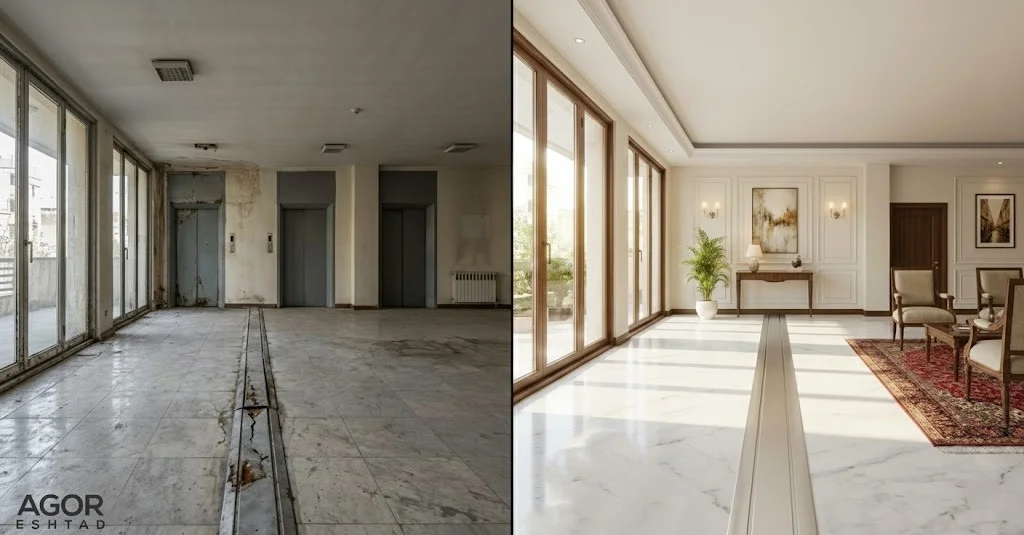
2. Technical report preparation and owner approval Providing before and after 3D renderings to gain resident satisfaction.
3. Site preparation
- Removing the old cover with low-noise cutting tools
- Repairing edge concrete with structural epoxy resin
4. Profile installation and sealing
- Positioning the RetroFit telescopic profile
- Sealing with clear silicone and PTFE strip
5. Final testing and delivery
- Movement test with hydraulic jack
- Water penetration test with 500 Pa pressure
Key implementation tips and challenge solutions
- Challenge of non-standard width: RetroFit series with telescopic profile is adjustable up to 100 mm.
- Challenge of facade preservation: Possibility of RAL powder coating exactly matching the existing facade color.
- Challenge of minimal disruption: Execution during night shifts and use of low-noise tools.
- Challenge of moisture penetration: Drain channel system is mandatory in all models.
- Safety: Use of suspended scaffolding and full insurance for the execution team.
Real case study: Rehabilitation of the 32-year-old Zafaranieh Tower in Tehran (2024-2025)
- Number of stories: 18
- Seismic joint area: 480 m²
- Main problem: Completely deteriorated old cover, water infiltration into the parking lot
- Solution: RetroFit series with 25-micron anodized aluminum + VMQ silicone strip
- Execution time: 18 working days (night shifts)
- Total cost: 1.8 billion Tomans
- Result:
- Complete elimination of water infiltration
- 22% increase in the value of upper-floor units
- 100% owner satisfaction
Conclusion
Rehabilitation of seismic joint covers in old buildings is a smart investment that both ensures resident safety and significantly increases property value. By choosing resistant materials (anodized aluminum, steel, or polycarbonate) and using Agor Ehtad’s specialized RetroFit, CrystalJoint, and MarinePro series, you can complete this project with minimal cost and disruption.
For a free assessment of your old building’s seismic joint condition and to receive a detailed technical proposal, contact the Agor Ehtad specialized team today. A complete report + 3D rendering + price will be provided within 48 hours.
FAQ
1. Is it possible to rehabilitate seismic joint covers while residents are living in the building?
Yes, it is entirely practical with night shift planning and low-noise tools.
2. What is the average cost of seismic joint rehabilitation?
8–35 million Tomans per square meter, depending on material and region.
3. Which model is best for old transparent lobbies?
The CrystalJoint PC series with multi-wall polycarbonate.
4. What is the warranty on Agor Ehtad products for rehabilitation projects?
10 full years for mechanical performance and color + 25 years for polycarbonate.
5. Does rehabilitation require a municipality permit?
In most cases, no, but for buildings above 12 stories, approval from the Engineering System Organization is required.