



Introduction
In modern construction projects, seismic joint covers play a key role in the safety and performance of structures. These covers, designed to prevent moisture penetration, pollution, and seismic damage, can turn a weak point into a strong point. According to a 2025 report by the Iran Engineering System Organization, over 35% of moisture and seismic problems in buildings were due to incorrect seismic joint covering.
In this article, we will examine the methods of closing and covering seismic joints, focusing on modern materials, standards, and implementation tips. Agor Naghsh Ehtad offers practical solutions with its specialized products. If you are an engineer or contractor, this guide will help you execute your projects safely and efficiently.
Why is closing seismic joints in buildings important?
A seismic joint is an essential gap between buildings to prevent collision during earthquakes or thermal changes. Without proper covering, these joints become weak points and facilitate the penetration of moisture or pollution. A 2025 BHRC report shows that 40% of moisture damage in structures results from uncovered joints.
Properly closing the seismic joint not only preserves aesthetics but also increases seismic safety. In high-risk areas like Tehran, proper covering can reduce damage by up to 50%. Agor meets this need with resistant products. For a basic understanding, read the article What is a seismic joint?.
Methods of covering seismic joints in buildings
After implementing the seismic joint, choosing the right covering method is key. Methods are selected based on joint width, environment, and standards. In 2025, modern materials such as smart composites have become popular.
Using metal sheets (aluminum or steel)
Metal sheets are weather-resistant and suitable for exterior facades.
Advantages:
- High UV resistance (lasts up to 50 years).
- Prevents water and dust penetration.
Disadvantages:
- Higher cost (1.5 million Tomans/m).
Example: In the Tehran Almas Tower project, Agor’s S series aluminum sheet was used.
Using elastomeric sealants
EPDM sealants are flexible and ideal for seismic zones.
Advantages:
- Absorbs earthquake vibrations (up to 30 cm movement).
Disadvantages:
- Requires UV coating.
Example: Shariati Hospital in Mashhad with the E series.
Polyurethane strips or mastic
Economical and fast for small joints.
Advantages:
- Low cost (800,000 Tomans/m).
Disadvantages:
- Lifespan of 10-15 years.
Special profiles for seismic joints
Modern composite profiles for luxury projects.
Advantages:
- Integration with IoT for monitoring.
Standards and requirements for seismic joint covers
Compliance with standards ensures safety. In 2025, updated standards emphasize sustainable materials.
National standards (Section 6 and 2800)
Minimum width 2 cm, flexible covering mandatory.
ASCE 7 and FEMA standards
Focus on energy absorption, performance testing.
Eurocode 8 standard
Width based on relative displacement, waterproof covering.
ASTM E1399 standard
Resistance test at temperatures from -30 to +80 degrees.
Comparison: National is simpler, international is more precise for seismic zones.
Implementation methods for seismic joint covers
Proper installation of the cover requires precision. In 2025, digital tools like lasers are helpful.
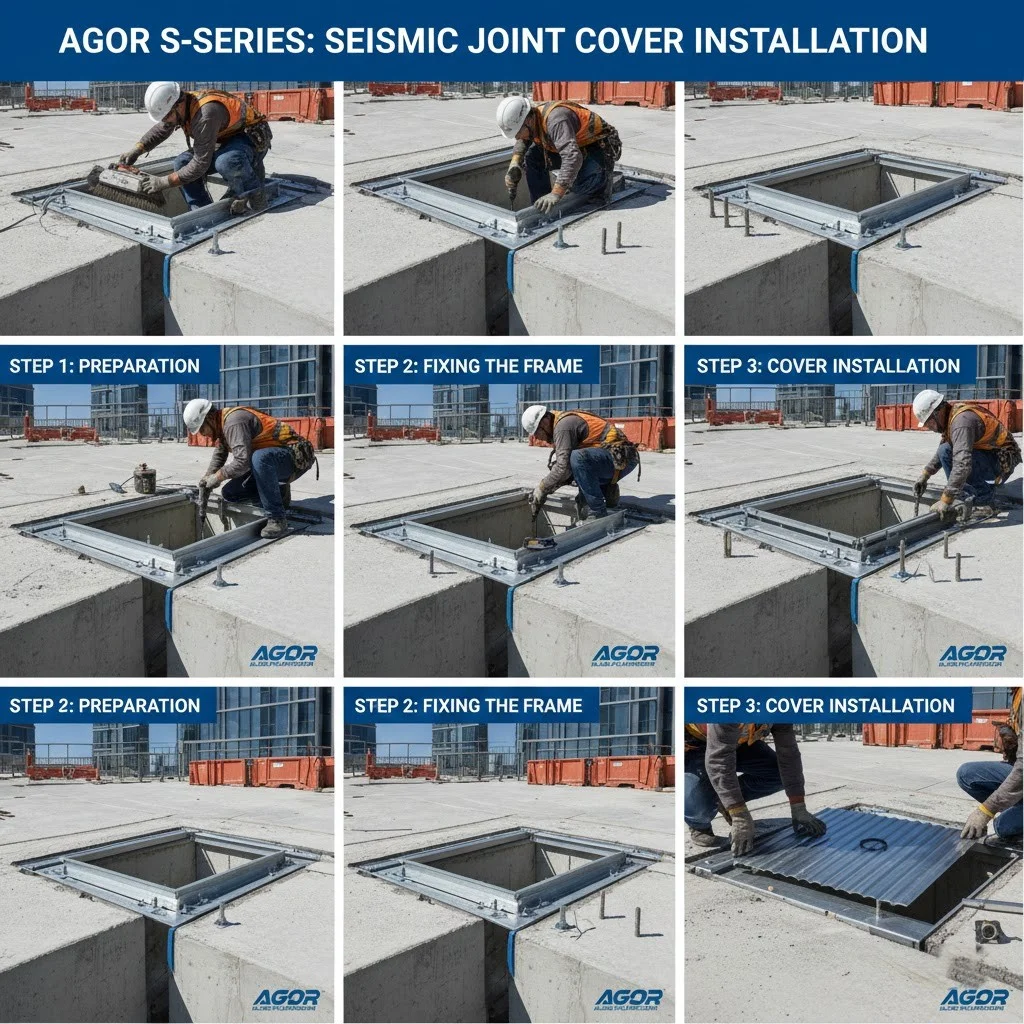
Installing metal sheets
- Surface cleaning.
- Sheet cutting.
- Installing fasteners.
- Sealing with silicone.
Example: Tabriz commercial project.
Elastomeric installation
- Preparation.
- Installing with adhesive.
- Sealing test.
Mastic installation
- Filling the filler.
- Injecting mastic.
- Smoothing.
Profile installation
- Measurement.
- Profile selection.
- Fixing with screws.
- Final sealing.
Agor products for seismic joint covers
Agor, with 24 exclusive profiles, offers modern covers.
S Series: Architectural seismic cover
- Feature: Flexibility up to 15 cm.
- Seismic joint cover for architectural spaces
O Series: External cover
- Feature: UV resistance.
E Series: Elastomeric cover
- Feature: Moisture insulation.
I Series: Thermal cover
- Feature: Energy savings.
Common problems and repair/maintenance methods
Problems like water penetration (35% of cases in 2025) are resolved with periodic repair.
Common problems
- Water penetration: Solution is EPDM.
- Cover failure: Replace with composite.
- Noise: Sound-absorbing foam.
Repair and maintenance
- Annual inspection.
- Replacement every 10 years.
“Modern covers reduce problems by up to 50%” (Journal of Structural Engineering, 2025).
Costs of seismic joint covers and impact on insulation
Costs have decreased in 2025 with local materials.
Cost table:
| Method | Cost (Tomans/m) | Insulation benefits | Metal<\/td> | 1.2-2 million<\/td> | Medium thermal<\/td> | Elastomeric<\/td> | 800,000-1.5 million<\/td> | Excellent acoustic<\/td> | Mastic<\/td> | 500,000-800,000<\/td> | Economical thermal<\/td> | Profile<\/td> | 1-1.8 million<\/td> | High for green buildings<\/td> |
|---|
Impact: 30% reduction in energy consumption with insulation.
Technical points for 2025
- Use of nano composites for 60-year durability.
- IoT integration for real-time monitoring.
- Sustainable materials for green roofs.
- Standard 2800 with new coefficients for humidity.

Case study / Sample project
Tehran Almas Tower
- Cover: S series, 50% damage reduction.
Shariati Hospital
- Cover: E series, excellent insulation.
Conclusion
Closing and covering seismic joints with modern materials and standards increases safety and efficiency. Agor, with its high quality and services, is the ideal choice.
FAQ
1. What is the best material for a seismic joint cover?
Elastomeric for seismic zones.
2. How much does a seismic joint cover cost?
500,000 to 2 million Tomans/m.
3. How do we repair a seismic joint?
By inspection and replacing the cover.
4. Does the seismic joint cover affect insulation?
Yes, up to 30% energy reduction.
5. What are the 2025 standards?
Section 6 with a focus on IoT.
To choose the right cover, contact Agor or download the catalog.